
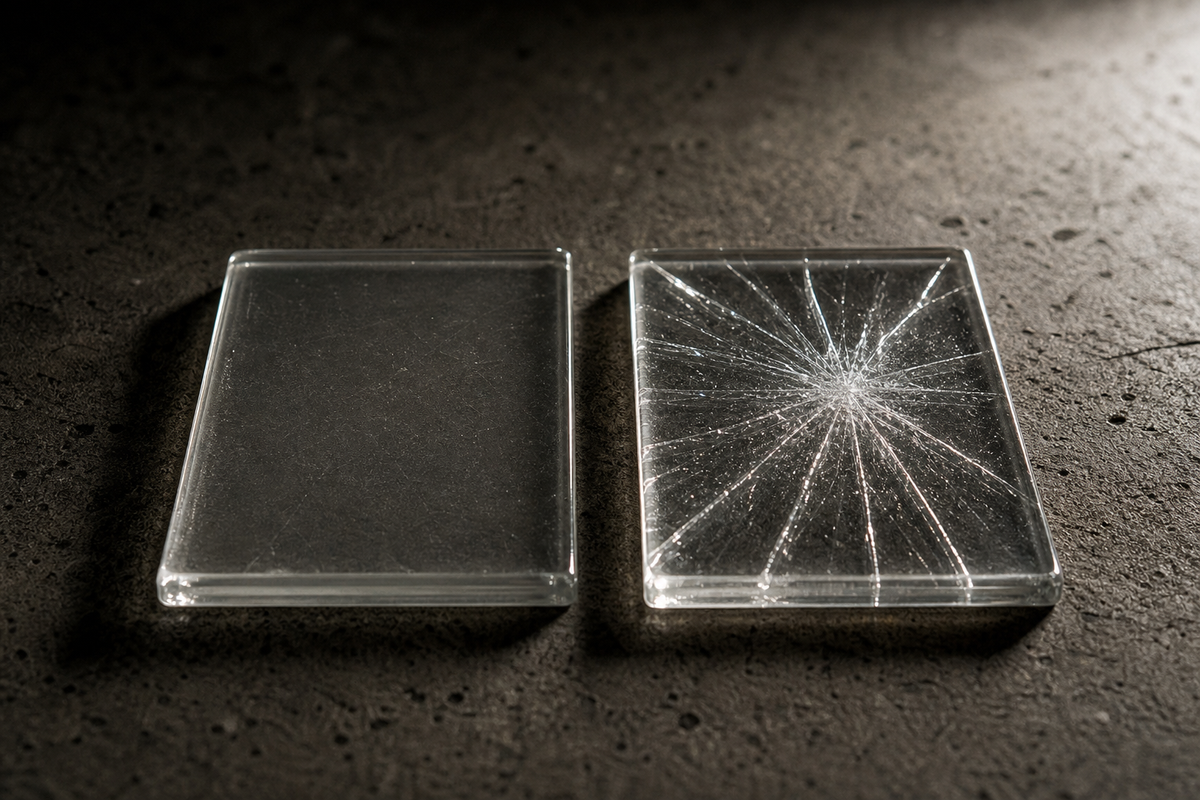
Two weeks ago we wrote that the worst thing that could happen to our cracked glass was that the resin would seal it so perfectly the crack would disappear. Then that is exactly what happened.
Our bottle carries a real crack, made by hand in a small plate of glass, set into a recess on the front of the bottle and sealed under clear resin. We explained the method, and why it is safe, in September. In that post we also said that a fracture which is perfectly sealed and perfectly invisible would be a failure. This is the story of that failure, of the experiments that followed, more than we could count, and of the surprisingly simple piece of physics behind all of it.
It also explains something you have probably seen without thinking about: why a stone chip in a car windscreen can be repaired so that you can barely find it.
Why can you see a crack at all?
A crack in glass is not a line of something. It is a thin gap, and the gap is full of air.
Light slows down and bends when it passes from one transparent material into another. How much it bends depends on a property called the refractive index. Glass has a refractive index of about 1.5; air is about 1. Wherever light crosses from glass into air, or back, it bends, and part of it is reflected.
A crack is a surface of glass-air boundaries, running in every direction at once. Each little facet catches the light and throws some of it back at you. That is why a crack looks bright, white or silvery, and why it flashes when you turn the glass. You are not seeing the crack itself. You are seeing light bouncing off the air inside it.
Now fill that gap with something that bends light the same amount as glass. The light no longer meets a boundary. It passes straight through as if the glass were whole, and the crack becomes much harder to see. Science teachers demonstrate this with a glass rod dipped in glycerin: the part of the rod under the liquid seems to vanish, because the glycerin and that kind of glass bend light almost identically.
Windscreen repair works on exactly this principle. When a stone chips a windscreen, the repair is a clear resin injected into the damage. The resin is chosen so that, once hardened, its refractive index is close to that of the glass. It replaces the air, and the bright star in your line of sight fades to a faint mark.
What went wrong for us
Our clear resin did what windscreen resin is designed to do.
When we set a cracked plate into the recess and poured the resin over it, the resin ran down into the fracture and filled it. The air that made the crack visible was pushed out. After curing, we had a smooth, sealed, perfectly clear plate, with almost no crack in it. The step that was supposed to protect the crack had erased it.
That was the one outcome we could not accept. The crack is the whole point of the bottle. Without it we have a very well-made plain bottle with a recess on the front.
Experiment after experiment
What followed was a long stretch of trial and error. We changed one thing, poured, waited, judged, and changed something else, over and over again. Every attempt needs the resin to cure before you can see the result, so each one costs days, not minutes, and most of them ended the same way: no usable crack.
Two of the directions we tried show how the problem kept moving.
Thicker glass. If the crack in a thin plate was too easy to fill, perhaps a thicker plate would make it stand out more. But a thicker plate needed to be held in place with an adhesive sticker, and the sticker trapped air bubbles against the glass. Bubbles are exactly what you do not want in a clear, polished finish. The result looked messy, not intentional.
Putting something into the crack. If the problem was that resin and glass bend light the same way, we could put something into the crack that bends light differently, such as a fine powder, so that the lines would show against the clear glass. In practice it did not work at all.
Attempt after attempt pointed to the same conclusion. The best material for making a crack visible is the one that was there from the beginning: air.
The fix that worked: seal the glass before you break it
The answer was to stop the resin from ever reaching the crack.
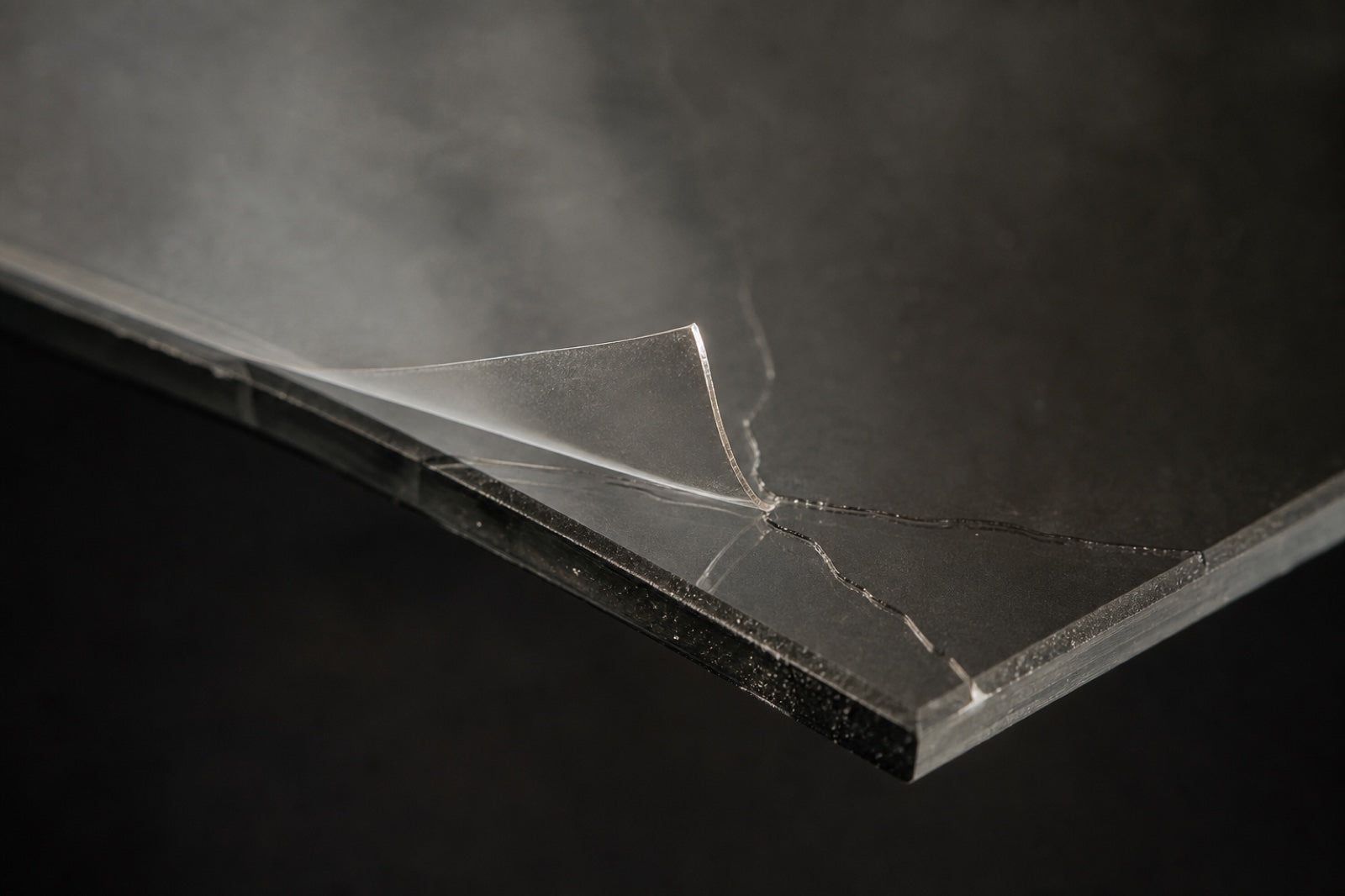
- Before the plate is broken, we cover both faces with a thin, clear film. The film is applied in a way that leaves no bubbles underneath, which also removed the problem the sticker had caused.
- Then we break the plate with the film still on. The glass cracks as before, but both surfaces stay covered and closed.
- The covered plate goes into the recess, and the resin is poured over it. The resin surrounds and seals the plate, but it cannot get into the fracture.
- The air stays inside the crack. After the resin cures, the crack is still full of tiny glass-air boundaries, and it still catches the light.
It is, in effect, the opposite of a windscreen repair. A windscreen repair works because the resin gets in. Ours works because it does not. What we are sealing inside every bottle is a little trapped air, in the shape of a crack.
What this changes
For the first time, we have a finish we are happy with: the crack clearly visible, the surface smooth and sealed, and no bubbles in the way. It took an enormous number of experiments to get here, and the answer turned out to be less about the resin than about what happens before the glass is ever struck.
It does not change what we said about safety. The crack is still in a separate plate, on the outside of a bottle whose own walls are whole, and it is still fully sealed. The only difference is that the seal now keeps the resin out of the crack as well as keeping everything in place.
What happens next
The experiments have not stopped. We are still testing and refining every variable around the method: how the film goes on, how the plate is struck, how the resin is poured and cured, how the surface is finished. Each bottle is finished by hand, one at a time, and we want every one of them to carry a crack that is as clear and alive as the best result we have seen so far.
Meanwhile the production parts are still on their way, as we wrote in The Bottle Is Made. We are not putting a date on the launch. But the question we raised two weeks ago, whether the crack would survive being sealed, now has an answer.
If you want to see the first finished bottle when it exists, our waitlist is where it will appear first; the link is in the footer.