
In perfume, "aldehydes" usually means a small family of synthetic materials that give a fragrance a bright, soapy, waxy, almost sparkling lift. They are most famous for their role in Chanel N°5. But the word causes more confusion than almost any other in perfumery, because chemists and perfumers use it differently, and because some materials sold as "aldehydes" are not aldehydes at all.
In this guide, we explain what an aldehyde is, what "aldehydic" means on a note list, where the N°5 story fits, and how to read the numbered names you will see on ingredient catalogues.
What is an aldehyde?
An aldehyde is an organic compound in which a carbonyl group (a carbon double-bonded to oxygen) is attached to at least one hydrogen atom. Chemists write the group as –CHO. That is the whole chemical definition. It says nothing about smell.
This is the first source of confusion. By that definition, a lot of very familiar smells are aldehydes:
- Vanillin, the main aroma compound of vanilla
- Cinnamaldehyde, which gives cinnamon its smell
- Citral, a major part of the smell of lemon
- Benzaldehyde, the smell of bitter almond
None of these is what a perfume description means when it says "aldehydic". A vanilla perfume is not called an aldehydic perfume.
What perfumers mean by "aldehydes"
When perfumers talk about "the aldehydes", they normally mean the aliphatic (fatty) aldehydes: straight or slightly branched carbon chains with the –CHO group at the end, roughly from eight to twelve carbon atoms long. Their names follow the chain length: octanal (C8), nonanal (C9), decanal (C10), undecanal (C11), dodecanal (C12).
These are not exotic. The University of Bristol's chemistry department attributes the fresh smell of orange juice and orange peel oil largely to the C8–C11 aldehydes, octanal to undecanal (Bristol, Molecule of the Month: octanal). The bulk of orange oil is limonene, which, the same page notes, has a very weak smell on its own. So part of what you recognise as "fresh orange peel" is, in fact, aldehydes.
The smell changes with the size and shape of the molecule. Bristol's page on N°5 notes that the odours of aliphatic aldehydes "vary strongly with the size and shape of the molecules", with short chains smelling sharp and unpleasant and the character softening as the chain gets longer (Bristol, Molecule of the Month: Chanel No.5).
Used at perfumery levels, the C10–C12 range is usually described with words like:
- waxy (like a candle that has just been blown out)
- soapy or clean laundry
- citrus peel
- metallic or fizzy, the effect often compared to champagne bubbles
One of the most used is 2-methylundecanal, sold under the trade name Aldehyde C-12 MNA. It is a branched C12 aldehyde, and supplier descriptions consistently call it aldehydic, waxy and clean, often with an ambery or slightly mossy facet.
What does "aldehydic" mean on a note list?
When a perfume is called aldehydic, or is placed in a "floral aldehydic" family, the description is telling you about an effect rather than a single ingredient: a bright, powdery-soapy brilliance, usually at the opening, that seems to lift the flowers off the skin.

It does not tell you which aldehydes were used, how much, or whether the effect lasts. Aldehydes sit mostly in the top of a composition, so the brightness is most obvious in the first part of wear. Our guide to top, heart and base notes explains why the opening of a perfume behaves differently from its dry-down.
Where N°5 fits
The fragrance most associated with aldehydes is Chanel N°5, launched in 1921 and composed by Ernest Beaux. Chanel's own product copy says Beaux presented "a visionary composition that made unprecedented use of aldehydes", and that Gabrielle Chanel chose the fifth sample.
The useful nuance is in the word use. N°5 was not the first perfume to contain these materials. Bristol's chemistry department notes that the perfumer Robert Bienaimé used 2-methylundecanal in Quelques Fleurs for Houbigant in 1912, and that Beaux himself followed in Rallet No. 1 (1914). N°5's top note is described there as aldehydes with 10–12 carbons, with the important addition of 2-methylalkanals (Bristol). What made N°5 famous was the scale and prominence of the aldehydes, not their invention.
You may also have heard that an assistant added far too much aldehyde by mistake. Bristol's page repeats this as one story among several. We have found nothing that confirms it, so we treat it as a legend.
Why "Aldehyde C-14" is not an aldehyde
Here is the part that surprises most people. On ingredient lists and supplier catalogues, you will find names such as:
- Aldehyde C-14 (also sold as "peach aldehyde"): actually gamma-undecalactone, a lactone. It smells of peach.
- Aldehyde C-16 (also sold as "strawberry aldehyde"): actually ethyl methylphenylglycidate, an ester. It smells of strawberry jam.
- Aldehyde C-12 MNA: 2-methylundecanal, a real aldehyde. It smells waxy, clean and aldehydic.
Both of the first two trade names are recorded as synonyms in the US National Library of Medicine's PubChem database (gamma-undecalactone, ethyl methylphenylglycidate). Neither molecule has the –CHO group that would make it an aldehyde. "Aldehyde C-16" does not even have sixteen carbon atoms.
These names are historical trade names that have survived from early catalogues. Perfumers still use them because everybody in the industry knows what they mean. For a reader, though, the lesson is simple: a material's trade name is a label, not a chemical description. If you see "aldehyde C-14" in a list of notes, expect peach, not soap.
How to smell aldehydes for yourself
You do not need a chemistry kit to recognise the effect:
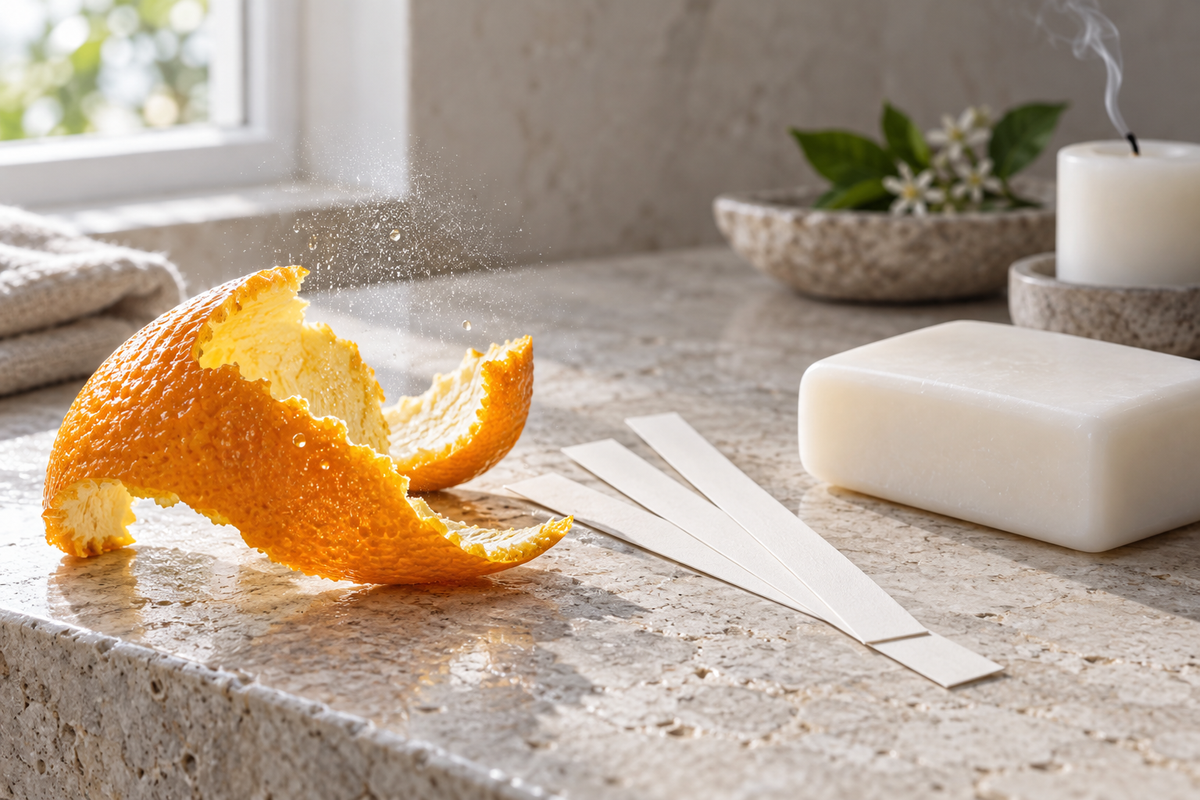
- Peel an orange and smell the peel closely, then from a little distance. The sharp, slightly waxy brightness at the edge is partly aldehydic.
- Smell a plain bar of soap or freshly washed cotton. Many "clean" accords rely on aldehydes or materials that imitate their effect.
- Compare the first minute and the first hour of a perfume described as aldehydic. If the soapy sparkle fades and the flowers remain, you have found where the aldehydes sat in the structure.
Some people find aldehydes old-fashioned because of their association with mid-century perfumes. Others love exactly that brilliance. Neither reaction is wrong; it is a matter of taste, and it helps to know which effect you are reacting to.
How we approach it at SHŌ ITO
We describe our perfume by the impression it makes, not by a list of molecules. When we write a material name, we try to make clear what kind of thing it is: a natural material, a synthetic molecule, an accord, or a trade name. We do the same in our guides to accords and to natural and synthetic ingredients.
This article explains a material family. It is not a statement about the formula of KIMONO, and we are not saying whether it contains aldehydes.
The short version: "aldehydes" in perfume usually means a handful of fatty aldehydes that add a waxy, soapy, citrus-peel brightness. N°5 made them famous, but did not introduce them. And a few of the best-known "aldehydes" on the market are not aldehydes at all.
If you would like more guides like this, you can join the SHŌ ITO newsletter through our website.