
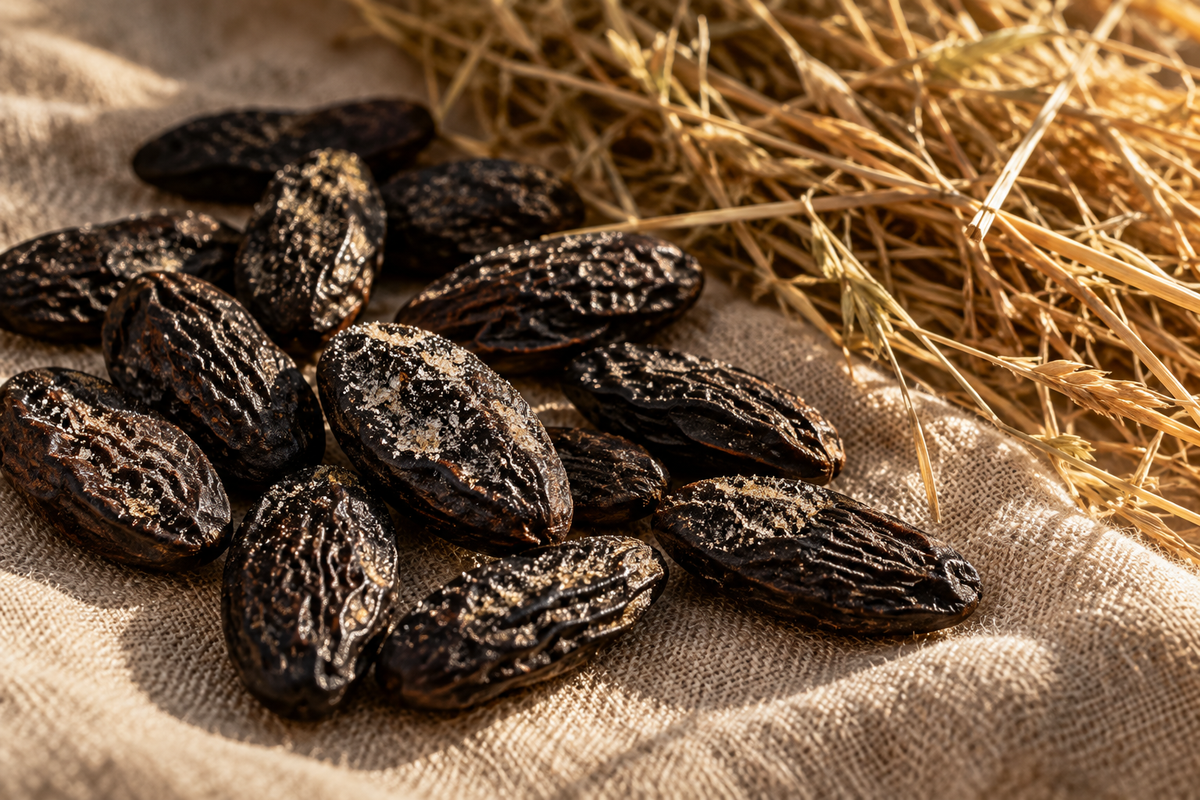
Tonka bean is the seed of a South American tree, and its warm smell of hay, almond and vanilla comes mainly from one molecule: coumarin. That same molecule is what you smell in a freshly cut, drying field. It was also one of the first natural scent molecules that chemists learned to make in the lab, and that changed perfume for good.
In this article we explain what tonka bean is, what coumarin smells like, why tonka beans cannot be added to food in the United States, and how to recognise tonka in a perfume.
What is tonka bean?
The tonka bean is the seed of Dipteryx odorata, a tree native to northern South America, especially along the tributaries of the Orinoco River. Each fruit holds a single seed, which is black and wrinkled when dried.
Most tonka beans come from wild trees. According to the plant reference PROSEA, the main producer is Venezuela, followed by Brazil and Colombia.
Fresh seeds do not smell very strong. They are traditionally cured: soaked for several days in strong rum or alcohol (45 to 65 percent) and then dried. After curing, the surface of the bean is often covered with fine white crystals. Those crystals are coumarin. Cured beans contain roughly 2 to 3 percent coumarin.
For perfumery, the beans are usually processed with solvents into a tonka absolute, a thick, concentrated extract. (We explained how absolutes are made in What Is an Absolute in Perfumery?.)
What does tonka smell like?
Tonka is usually described as:
- Hay-like, like grass drying in the sun
- Almond-like, close to marzipan
- Vanilla-like and sweet, but drier and less sugary than vanilla
- Slightly tobacco-like and warm, with a faint spicy edge
On skin, tonka feels comforting and soft. It often sits in the base of a perfume, under woods, lavender, amber or vanilla, where it adds warmth without heaviness.
The molecule behind it: coumarin
Coumarin is a fragrant molecule found in many plants. Chemically, it is 1,2-benzopyrone, with the formula C9H6O2.
Its history is closely tied to the tonka bean. In 1820, the molecule was isolated from tonka beans. In fact, the name coumarin comes from "coumarou", a French word for the tonka bean, which in turn comes from the Tupi name for the tree.
Why a cut field smells of coumarin
Coumarin is also responsible for the sweet smell of new-mown hay. In plants such as sweet clover and sweet vernal grass, a precursor of coumarin is stored bound to a sugar. When the plant is cut and begins to wilt, the cells break down, an enzyme removes the sugar, and the freed molecule closes into coumarin. That is why a field smells sweeter after mowing than before.
So when a perfume note says "hay", it is very often coumarin you are smelling.
Other places you meet coumarin
Coumarin also occurs in sweet woodruff and in cassia cinnamon. This is why some cinnamon-heavy foods can contain noticeable amounts of it, and why the European Union sets maximum levels of coumarin in certain foods.

Why tonka beans are banned in food in the United States
Here is the part many people do not expect. In the United States, food containing added coumarin, including coumarin added through tonka beans or tonka extract, is considered adulterated. The rule is set out in the US Code of Federal Regulations, 21 CFR 189.130, and goes back to an order of March 1954.
The concern is the liver. Coumarin can harm the liver when large amounts are taken in by mouth, which is why food safety bodies set limits on how much people should eat. The European Food Safety Authority, for example, set a tolerable daily intake for coumarin.
Two points are important here:
- This is a food rule. It is about eating coumarin, not about wearing it.
- Tonka beans are not illegal to own in the US. They simply cannot be added to food sold there.
Chefs in Europe use tonka in desserts in small amounts, while in the United States it cannot be used that way. This is a good example of how the same ingredient is regulated differently depending on how it is used.
Is coumarin safe in perfume?
Coumarin is allowed in perfumes in the European Union and elsewhere, but it is controlled in two ways:
- Labelling. Coumarin is one of the fragrance substances that must be named in the ingredient list of a cosmetic product in the EU when it is present above 0.001 percent in leave-on products, such as perfume, or above 0.01 percent in rinse-off products. This rule has existed for many years. It exists because a small number of people are allergic to it, so they can check the label.
- Maximum levels. The International Fragrance Association (IFRA) publishes standards that limit how much coumarin can be used in different types of products.
If you see "Coumarin" on a perfume box, it does not mean the perfume is unsafe. It is information for people who know they react to it. (We explained the newer, longer allergen lists in our article on the new EU allergen labels.)
How coumarin changed perfume
In 1868, the English chemist William Henry Perkin made coumarin in the laboratory from other chemicals. This was one of the first times a natural scent molecule was produced by chemical synthesis.
Synthetic coumarin was soon used in perfume. In 1882, Houbigant released Fougère Royale, created by Paul Parquet. It combined lavender, oakmoss and coumarin into a new shape that gave its name to an entire fragrance family, the fougère (French for "fern"). In 1889, Guerlain's Jicky also made notable use of coumarin.
The fougère family is still with us. Many classic and modern men's fragrances are built on the same idea: something fresh and aromatic on top, and the warm hay-like softness of coumarin underneath. If you would like to understand how perfumers combine materials into a new impression like this, see What Is an Accord in Perfumery?.
Tonka bean vs coumarin: what is the difference?
| | Tonka bean (absolute) | Coumarin | |---|---|---| | What it is | A natural extract of the bean | A single molecule | | Smell | Coumarin plus many other compounds: richer, darker, with tobacco, almond and caramel facets | Clean hay, sweet, slightly almond-like | | Source | Seeds of Dipteryx odorata | Found in tonka and other plants; usually made synthetically today | | In a note list | Often written "tonka" or "tonka bean" | Often written "tonka", "hay" or simply not named |
In other words, "tonka" in a note list may mean the natural extract, synthetic coumarin, or both. Like "sandalwood" or "amber", the name describes an impression more than a single ingredient.
How to recognise tonka in a perfume
Try this the next time you smell a perfume that lists tonka:
- Wait. Tonka is a base note, so it appears after 30 minutes or more.
- Look for "warm but not sugary". If it smells sweet like almonds or hay rather than sweet like candy, that is often coumarin.
- Compare with vanilla. Vanilla feels creamy and edible. Tonka feels drier, more like hay and tobacco.
How we think about it at SHŌ ITO
We like materials like tonka because they connect perfume to ordinary memories, like a cut field in summer or an almond pastry, rather than to abstract luxury. We would rather you understand that "tonka" points to coumarin and to hay than be impressed by an exotic word.
When we describe our own perfumes, we try to tell you what impression a material gives, so you can decide whether it is for you.
Key takeaways
- Tonka bean is the seed of Dipteryx odorata, a South American tree. Beans are cured in alcohol and covered in crystals of coumarin.
- Coumarin smells of hay, almond and soft vanilla. It is the same molecule behind the smell of new-mown hay.
- In the United States, adding coumarin or tonka to food has been prohibited since 1954 (21 CFR 189.130). This is a food rule, not a perfume rule.
- In EU cosmetics, coumarin must be named on the label above set thresholds, and IFRA limits how much can be used.
- Perkin synthesised coumarin in 1868. Fougère Royale (1882) used it to create the fougère family.
If you enjoy learning about perfume materials, you can find more in our Journal, and you can join the SHŌ ITO newsletter through our website.