
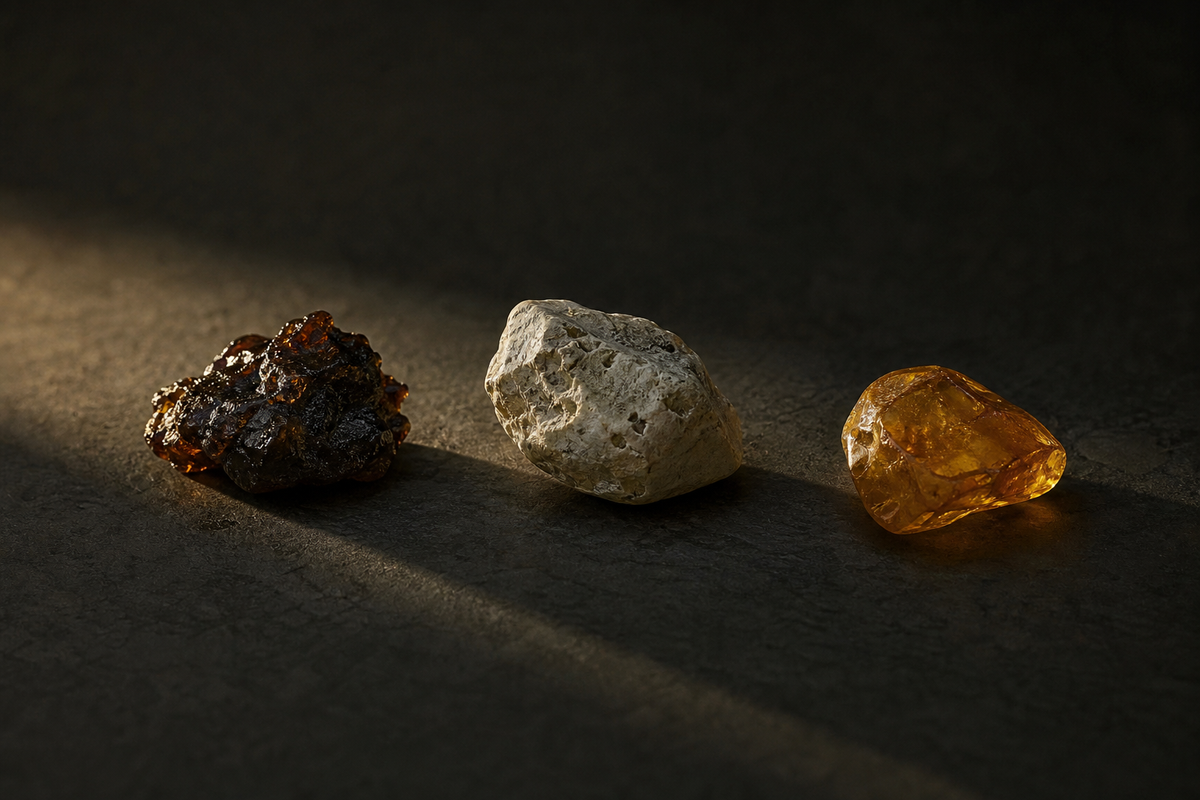
In perfume, "amber" is not a raw material. It is an accord — a blend of several materials that together read as one warm, resinous, slightly sweet smell. It is not made from the fossilised tree resin sold as jewellery, and it is not ambergris, the rare substance that comes from sperm whales. The three share a name for historical reasons, and that shared name causes more confusion than almost any other word on a perfume label.
In this article we explain what each of the three ambers is, where the confusion comes from, what "Ambroxan" on an ingredient list really refers to, and how we use the word ourselves.
Three things called amber
1. The amber accord
When a perfume description says "amber," it almost always means an accord: a small group of materials blended so that they merge into a single impression. (We explain accords in detail in What Is an Accord in Perfumery?.)
The Perfume Society describes amber as "a simple fragrance accord of labdanum, benzoin and vanilla – and/or, sometimes, touches of tonka and Peru balsam." In plain terms:
- Labdanum — a sticky resin from the rockrose shrub (Cistus). It gives amber its dark, leathery, slightly animal depth.
- Benzoin — a balsamic resin with a soft, vanilla-like sweetness.
- Vanilla or vanillin — the sweetness that rounds everything off.
- Tonka bean and Peru balsam — optional extras that add warmth and a toasted, almost caramel edge.
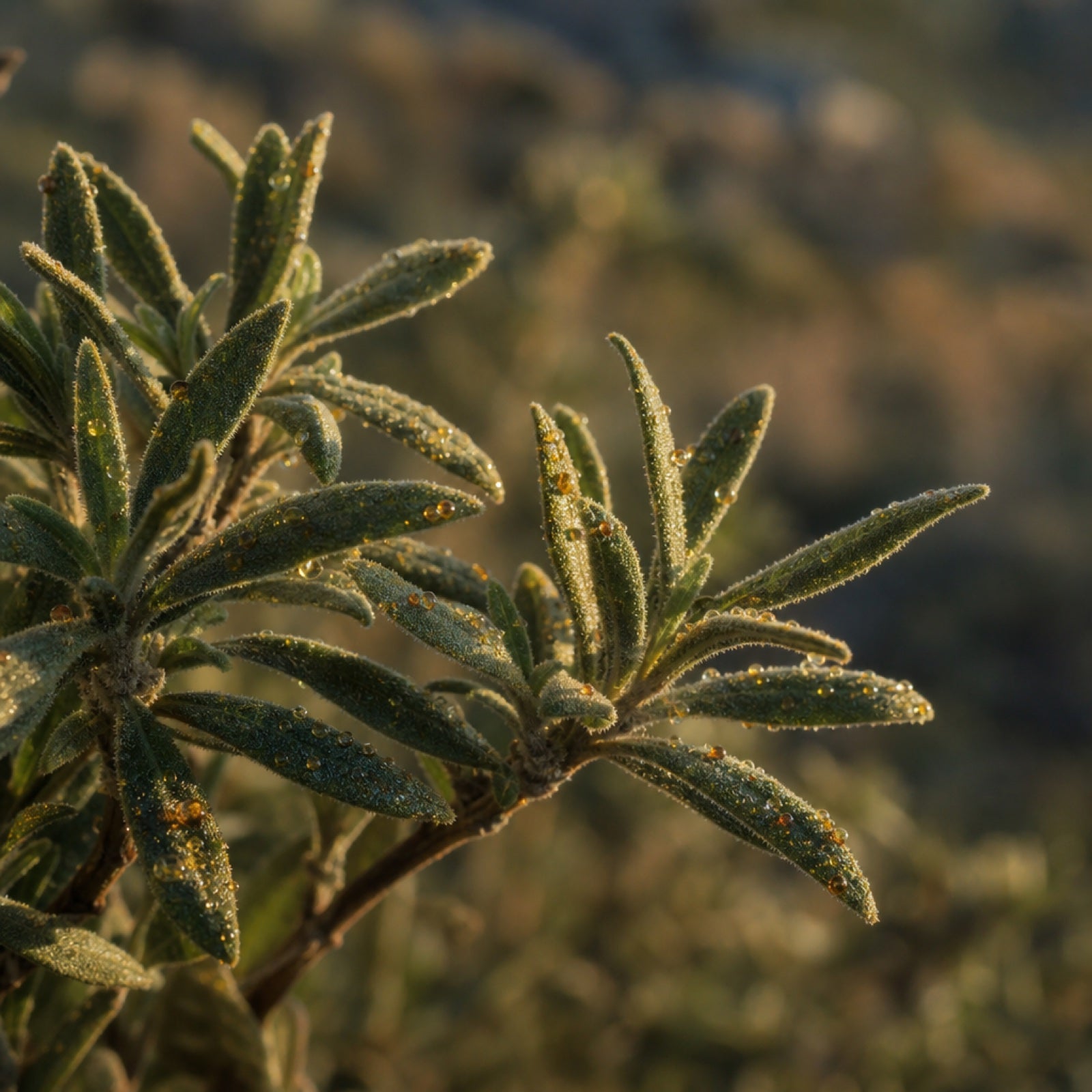
Labdanum is the backbone, and it has a long history. It is exuded by tiny glandular hairs on the leaves of the rockrose. Historically it was gathered in two remarkable ways: combed from the bushes with a bow-shaped tool with leather straps called a ladanisterion, and collected from the beards of goats that had grazed among the plants. According to JSTOR Daily, the traditional harvest now survives in only one or two villages on Crete.
2. Ambergris
Ambergris is something else entirely. The US government's fisheries agency, NOAA, describes it as "a naturally occurring by-product of sperm whale digestive tracts sometimes found on beaches," formed "when secretions form around squid beaks and cuttlefish parts in the intestinal tract of a whale."
Fresh ambergris barely smells of anything useful. Its main component, a compound called ambrein, is odourless. As a lump of ambergris ages — often while drifting at sea for years — ambrein slowly oxidises, and one of the products is (−)-Ambroxide, the molecule largely responsible for ambergris's distinctive smell: soft, radiant, slightly salty and woody.
Its legal status depends on where you are. In the United States, NOAA states plainly: "You may not collect, keep, or sell ambergris because it is a part from an endangered marine mammal."
3. Fossil amber
The golden stone used in jewellery is fossilised tree resin from ancient forests. It is not a perfume material in any normal sense. An oil can be distilled from it by heating, but that is a harsh, smoky product with a history in old pharmacy rather than in fine perfumery.
Why three different things share one word
The confusion is centuries old. The word amber comes from the Arabic 'anbar, which meant ambergris. In medieval Europe the word spread to the fossil resin too, and French kept the two apart with colour words: ambre gris (grey amber, ambergris) and ambre jaune (yellow amber, the fossil resin). One likely reason for the overlap is that both were found washed up on seashores.
Perfumery added a third meaning in the late 19th century. The Perfume Society dates the amber accord to the period after synthetic vanillin was invented. According to Fragrances of the World, the French chemist Georges de Laire launched a perfume base called Ambre 83 in 1889 — described by the ingredient house Symrise as "an intricate blend of synthetic Vanillin, along with natural ingredients including vetiver, patchouli and jasmine." Guerlain's Jicky followed the same year. By 1931, the perfumer Félix Cola's published formula for "Ambre Synthétique No 3" contained nitro musks, vanillin, benzoin, tolu balsam, and smaller amounts of incense, vetiver and patchouli — recognisably the accord we still call amber.
Even today the industry does not always keep the meanings apart. Fragrances of the World notes that the trade "often uses amber as a simple way to describe ambergris as well as a group of related 'woody-amber' ingredients."
From "oriental" to "amber"
The word gained a fourth job in June 2021, when the fragrance classification expert Michael Edwards announced in a release titled "It's Time to Change" that his Fragrances of the World would replace the family name "Oriental" with "Amber" in all English-language classifications. Many brands have since followed. So when a shop groups perfumes under "amber," it means the whole family of warm, resinous, sweet and spicy scents — not just the accord. (More on the families in our guide to fragrance families.)
What "Ambroxan" on a label means
If you read ingredient lists or perfume reviews, you will meet Ambroxan — sometimes called Ambrox, Ambrofix, Ambroxide or other trade names, depending on which company makes it. These are all names for essentially the same molecule: the key odorant of aged ambergris, made without the whale.
Its history is a story of chemistry. The Swiss house now called dsm-firmenich says it began decoding ambergris in the 1930s and synthesised Ambrox in the 1950s. The classic route started from sclareol, a compound from clary sage; in 1988 the company developed a new synthetic route specifically "to avoid the clary sage shortage."
So a perfume described as "ambery" and a perfume containing Ambroxan are not necessarily related. The first usually means the labdanum-and-vanilla accord. The second means an ambergris-type molecule, which smells drier, airier and more mineral.
Why some people barely enjoy ambergris notes
A 2025 study in Communications Biology identified the smell receptor, OR7A17, that responds to (−)-Ambroxide. The researchers found that non-working versions of this receptor are common, especially in East Asia. People without a working copy could still detect the molecule, but rated its smell as less pleasant. The authors link this to historical accounts that East Asian users of ambergris valued it as a fixative rather than for its own scent.
If an "ambergris" perfume smells flat or faintly odd to you, this may be why. It is not a failure of your nose. It is a difference in your genes.
Why does amber smell "warm"?
People almost universally call amber a "warm" smell. But smells have no temperature, and the association is less universal than it seems. A 2017 study in Frontiers in Psychology compared how speakers in different cultures matched smells to hot and cold. The pairings that were consistent within one culture differed from those in another, "arguing against their universality."
The best explanation is learned association. Vanilla, resins, spices and toasted notes are what many of us have learned to connect with baking, fires, and closed rooms in winter. That makes amber warm for many people, but not by nature.
How we use the word at SHŌ ITO
Because one word covers at least three different things, we have made a simple rule for our own writing: when we say amber, we will say which amber we mean.
- If we mean the accord, we will name what it is made of — labdanum, benzoin, vanilla, or whatever else it really contains.
- If we mean an ambergris-type note, we will say so, and we will not blur it into the accord.
- We will not use "amber" as a mood word standing in for "warm" or "cosy."
This is part of a broader habit we try to keep in this Journal: using the vocabulary of perfumery in ways that help you understand what is actually in a bottle. Natural versus synthetic, oud and amber are three of the words most often used loosely on perfume labels.
Summary
- Amber in perfume is an accord, usually built on labdanum, benzoin and vanilla.
- Ambergris is a rare substance formed in sperm whales; its smell comes from (−)-Ambroxide, which develops as the ambergris ages.
- Fossil amber is fossilised tree resin and is not a normal perfume material.
- Ambroxan and its relatives are ambergris-type molecules, not the amber accord.
- Since 2021, "Amber" has also replaced "Oriental" as the name of a fragrance family.
If you would like more explainers like this one, our newsletter, The Hidden Nose, arrives every Sunday; the sign-up link is in the footer.