
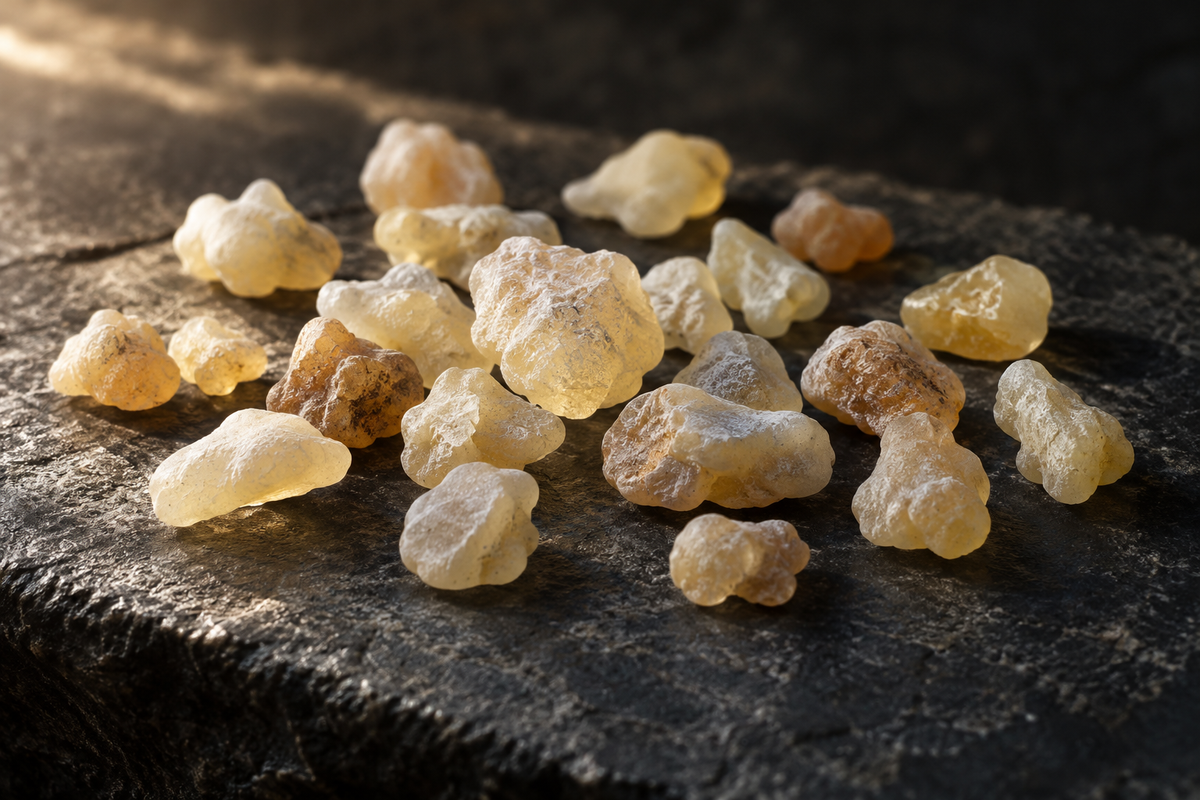
Frankincense, also called olibanum, is an aromatic gum-resin from Boswellia trees. In perfume, its extracts can smell citrusy, peppery, woody and resinous. A fragrance that lists frankincense therefore does not have to smell like something burning. That is the useful surprise behind a material so closely associated with incense.
The key is to separate the raw resin, the extract used by a perfumer, and the overall incense impression of a finished fragrance. They are connected, but they are not interchangeable.
Frankincense and olibanum: two names, several trees
Frankincense is not the name of one isolated aroma molecule. It is a botanical material obtained from trees in the genus Boswellia. Olibanum is another name you will encounter for that material. Kew's plant profile for Boswellia sacra records both names and describes the resin's use in perfumery.
The tree produces gum-resin that hardens after emerging from cuts in its bark. The collected pieces are often called tears. They are irregular natural pieces, not beads manufactured to a uniform size. Their appearance can vary, as the specimens discussed in Kew's frankincense collection article illustrate.
Several Boswellia species supply frankincense. That is a reason to be careful with a phrase such as “the smell of frankincense”: it compresses botanical variation and processing choices into one familiar word. A note list rarely gives you all that detail.
Why a perfume extract can smell brighter than expected
Consider the essential oil first. This is an extract obtained by distillation, rather than a handful of resin dissolved into a finished perfume without further processing.
IFF's olibanum oil entry lists gum-resin as the starting material and hydrodistillation as the process. It describes a peppery incense character with citrus at the opening and an ambery resinous undertone. Those citrus and pepper associations are part of the oil's described character; they do not mean that lemons and peppercorns must have been mixed into it.
A second ingredient manufacturer, dsm-firmenich, describes its olibanum essential oil as fresher and more citrus-focused than the resinoid. Its profile also includes green, woody and balsamic aspects. Here, “balsamic” is perfume vocabulary for a resin-associated character, not a reference to vinegar.
That comparison is the important point. The perfume industry does not have only one frankincense material with one unchanging balance. An extract can emphasise brightness while still being recognisably related to the resin.
What is an olibanum resinoid?
A resinoid is another type of extract. In the specific case documented by IFF, olibanum resinoid is made from gum-resin using ethyl alcohol. Its description combines resinous incense, pepper, citrus, mineral facets and a woody-ambery background.
That does not mean all resinoids are identical, or that every resinoid smells dark. Notice that citrus remains in this description too. “Oil equals fresh; resinoid equals smoky” would be an overly tidy rule. The better distinction is that different extraction routes provide different materials, whose individual profiles need to be considered.

Nor does “resinoid” automatically describe the concentration of a perfume in a bottle. It describes an ingredient extract. Our guide to absolutes and extraction explains why it helps to keep the extraction method separate from the finished fragrance's name.
Does an incense note mean actual smoke?
Not necessarily. When reading a perfume description, start by asking what level of description you have been given. “Olibanum essential oil” is relatively specific. “Frankincense” names a material more broadly. “Incense” can describe the overall impression the writer wants you to imagine.
We would not infer a formula from that last word alone. A description of a church-like, resinous or smoky atmosphere is not an inventory of the materials that created it. Likewise, the presence of frankincense in a description does not tell you how prominent smoke will be in the finished fragrance.
An accord is a combination built to produce a larger impression. Our accord guide offers a way to read that kind of description without mistaking it for a literal recipe. The practical consequence is that disliking one very smoky perfume does not settle whether you like frankincense in every setting.
How we suggest reading the description
At SHŌ ITO, we would begin with three questions rather than a mental picture of a smoking incense burner.
What is actually named? Look for frankincense, olibanum, an essential oil, a resinoid, or simply incense. More specific wording gives you more to work with, although it still does not describe the complete formula.
Which direction is emphasised? A description centred on citrus and pepper suggests a different starting expectation from one centred on smoke, leather or dense amber. Treat that as a guide to comparison, rather than a guarantee that you will experience the same associations.
What do you notice yourself? Write down the first impression before reading a review. Return later and describe what remains. If the fragrance seems bright and dry rather than smoky, there is no need to decide you have smelled it incorrectly.
For a useful comparison, choose two finished fragrances that both mention incense but describe it differently. Give each the same attention. Try to distinguish the resinous impression from the surrounding sweetness, woodiness or spice. You do not need to identify individual ingredients to learn which balance you enjoy.
We are explaining the material, not announcing frankincense as an ingredient in KIMONO. For this article, the practical lesson is about reading perfume language more accurately: a name associated with burning can also lead to a bright, peppery perfume material.
Frankincense and olibanum refer you back to a resin. The extraction method helps explain what a perfumer can do with it. The finished fragrance remains the thing to judge.
You can join the SHŌ ITO newsletter through our website for more guides to the materials and choices behind perfume.