
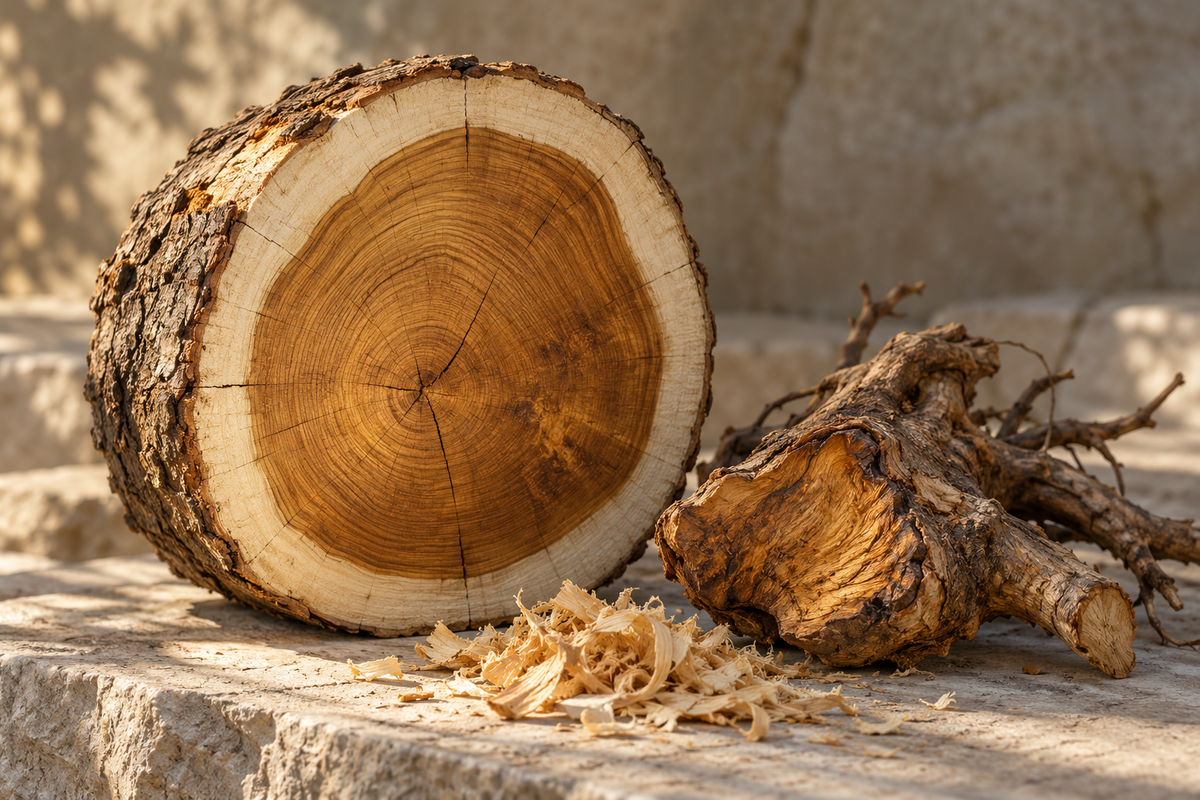
**Sandalwood in perfume is the oil distilled from the scented inner wood, called heartwood, of trees in the genus Santalum.** It smells soft, creamy and warmly woody, and it is one of the oldest materials in perfumery. It also comes from a surprising plant: a tree that cannot grow well on its own, because it takes part of what it needs from the roots of its neighbours.
In this article we explain what sandalwood is, why the best of it takes decades to form, how the main types differ, and why many "sandalwood" perfumes today rely on modern molecules.
A tree that borrows from its neighbours
The classic sandalwood is Santalum album, often called Indian or East Indian sandalwood. Botanically, it is a hemiparasite, or partial parasite.
That means the tree has green leaves and makes its own food from sunlight, like any other tree. But its roots also grow small connecting organs, called haustoria, which attach to the roots of nearby plants and draw water and nutrients from them.
This has a practical consequence. A sandalwood seedling planted alone grows poorly. Foresters plant it together with "host" or "nurse" species, and plants that fix nitrogen and give light shade are preferred (World Agroforestry tree database). Researchers have found that the choice of host affects how well young sandalwood grows.
So when you smell sandalwood, you are smelling a tree that, in a quiet way, depended on other trees to become what it is.
Where the scent is: the heartwood and the roots
A sandalwood tree does not smell strongly all the way through. The fragrant oil sits in the heartwood, the dense, darker core of the trunk. The outer wood around it, called sapwood, has little scent.
Heartwood takes time to form. Under natural conditions, Santalum album reaches a harvestable size (over 15 cm in trunk diameter) in about 30 years, and a well-grown tree at around 40 years can yield over 250 kg of scented heartwood, including the roots (World Agroforestry tree database). Trees on difficult, dry sites often grow slowly but build up more heartwood with a higher oil content than trees on rich, moist soil.
Here is the part that surprises most people: the roots contain the highest concentration of oil. For that reason, sandalwood is traditionally harvested by taking the whole tree, roots included, rather than cutting the trunk and leaving the stump.
The oil itself is made by steam distillation of the heartwood, which has been chipped or powdered. Heartwood yields roughly 4 to 10 percent oil, depending on the tree.
What does sandalwood smell like?
Good sandalwood oil is usually described as:
- Creamy and milky, rather than dry like cedar
- Soft and round, with no sharp edges
- Slightly sweet, sometimes with a faint rosy or balsamic tone
- Quiet but very long-lasting, staying close to the skin for hours
Because it lasts so long and blends well, sandalwood often works as a base that holds a perfume together. It softens sharper materials and makes the dry-down feel smooth.
The chemistry in one paragraph: santalols
Sandalwood oil contains more than 100 odorant compounds, but two molecules matter most: α-santalol and β-santalol. They belong to a family of molecules called sesquiterpene alcohols, and together they make up most of a good oil.
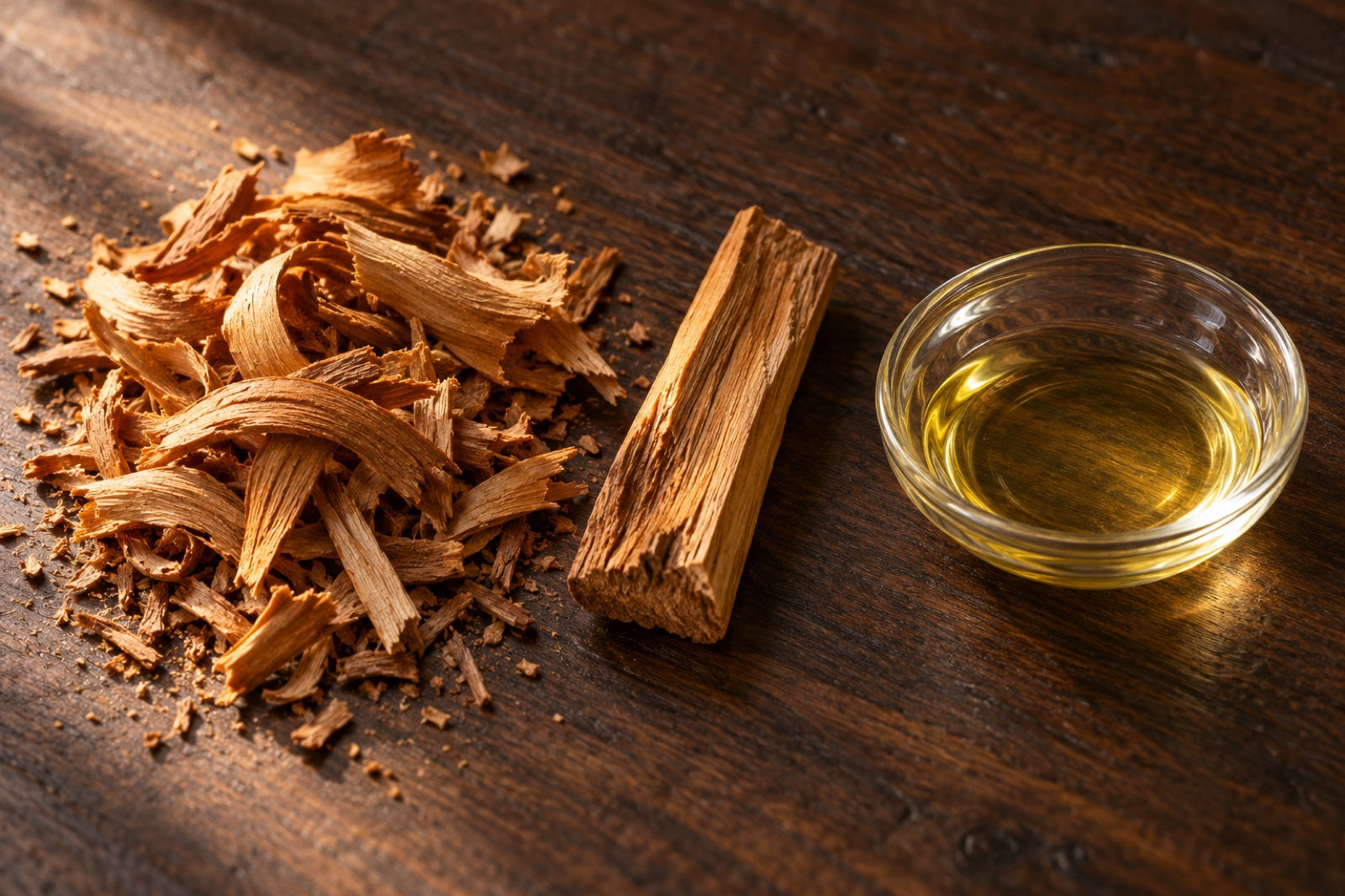
There is an international standard for this oil, ISO 3518, which describes oil from Santalum album heartwood. It requires roughly 41 to 55 percent α-santalol and about 16 to 24 percent β-santalol. A 2021 study published in the journal Molecules tested six commercial oils sold as "sandalwood" and found that none of them met this standard. That is one reason the word "sandalwood" on a label tells you less than you might think.
The main types of sandalwood
| Type | Species | Where it grows | What to know | |---|---|---|---| | Indian (East Indian, Mysore) | Santalum album | Southern India, Indonesia and Timor; now also grown on plantations | The classic reference. Rich in santalols. Wild populations are listed as Vulnerable by the IUCN. | | Australian | Santalum spicatum | Native to Western Australia | Drier and sharper, with a lower santalol content. Covered by a separate standard, ISO 22769. | | Plantation Indian | Santalum album | Large plantations in northern Western Australia, among other places | The same species as Indian sandalwood, grown under management rather than taken from the wild. | | Pacific species | e.g. Santalum austrocaledonicum, Santalum paniculatum | New Caledonia, Vanuatu, Hawaii | Smaller volumes; each has its own character. |
Why "Mysore" became a byword for quality
For much of the 20th century, the most famous sandalwood came from the region around Mysore, in what is now the Indian state of Karnataka. In 1916 a Government Sandalwood Oil Factory was set up there, and its oil, along with the well-known Mysore Sandal Soap, made the name famous. Today "Mysore Sandalwood Oil" is a registered Geographical Indication in India.
Over-harvesting and illegal cutting reduced the wild trees, and supply from the region shrank sharply. When a perfume today mentions "Mysore sandalwood", it is worth asking where the oil really came from. Much of the Santalum album oil on the market now comes from managed plantations.
Synthetic sandalwood: why it is everywhere
Because natural sandalwood is slow to grow and limited in supply, chemists developed molecules that smell like it. Some of the best known are:
- Sandalore, Ebanol and Javanol (developed by Givaudan)
- Polysantol (developed by Firmenich)
These are not copies of santalol. They are different molecules that our noses read as "sandalwood". Javanol is especially powerful: a trade review in Perfumer & Flavorist reported that its odour threshold, the smallest amount a person can detect, is more than 20 times lower than that of β-santalol.
Each synthetic shows a different side of the wood. Some are creamier, some drier, some more rosy. Perfumers often combine several of them, sometimes with a little natural oil, to build a full sandalwood effect.
This is not a shortcut in a negative sense. Synthetic sandalwoods let perfumers use a sandalwood character widely without depending on a threatened tree. If you want to understand this balance better, we wrote about it in Natural vs Synthetic Perfume Ingredients.
How to read "sandalwood" on a perfume
When you see sandalwood in a list of notes, it could mean:
- **Natural Santalum album oil**, from wild or plantation trees
- Natural oil from another species, such as Australian sandalwood
- One or more synthetic sandalwood molecules
- A mix of the above, built into a sandalwood accord
None of these is automatically "better" for you as a wearer. They simply smell different. Natural Indian sandalwood tends to be creamier and rounder. Australian sandalwood is often drier and greener. Synthetics can be very clean and very long-lasting.
A simple way to learn the difference is to smell sandalwood-focused perfumes on skin, not just on paper, and to come back to them after two or three hours. Sandalwood shows itself mostly in the dry-down.
How we think about it at SHŌ ITO
We keep writing about single materials because the same word on a label can describe very different things. "Sandalwood", like "oud" or "amber", can mean a natural oil, a modern molecule or a blend built to give an impression.
When we describe our own perfumes, we prefer to tell you what impression a material gives, rather than use its name as a badge of quality. A beautiful creamy wood in a perfume is the result of how materials are combined, which is what we explain in What Is an Accord in Perfumery?.
Key takeaways
- Sandalwood oil is distilled from the heartwood of Santalum trees. The roots hold the most oil, so trees are traditionally harvested whole.
- Santalum album is a hemiparasite: it attaches to the roots of host plants and takes water and nutrients from them.
- Under natural conditions the tree needs about 30 years to reach harvestable size.
- The key scent molecules are α-santalol and β-santalol. The ISO 3518 standard sets ranges for both.
- Indian (S. album) and Australian (S. spicatum) sandalwood are different species with different smells.
- Many sandalwood perfumes use synthetic molecules such as Javanol, Ebanol, Sandalore and Polysantol, alone or with natural oil.
If you enjoy learning about perfume materials, you can find more in our Journal, and you can join the SHŌ ITO newsletter through our website.