

This week we started finishing bottles by hand. Not the production bottles yet — those parts are still on their way, as we wrote last week — but the sample bottles we have here, which we are using to rehearse the last steps before the real ones arrive. It is the part of the bottle that we kept for ourselves, and it is the part people ask about most: how do you make a bottle that looks cracked without making a cracked bottle?
The short answer is that the crack is never in the bottle. It is made separately, by hand, in a small plate of glass, and then set into the bottle and sealed. This post explains that in detail, why it makes the bottle safe, why the work has to be done one bottle at a time, and what the crack is there to say.
What "finishing" normally means for a perfume bottle
A glass bottle comes out of its mould plain. Everything you then see on it is added afterwards, in a stage the industry calls decoration. Glass makers offer a fairly fixed set of techniques: screen printing, hot foil stamping, spraying or lacquering, digital printing, frosting, and the gluing-on of accessories such as collars and plaques. That is the standard toolkit, and it is a good one.
Every technique in it, though, starts from the same assumption: that the glass underneath is flawless. Decoration adds colour, text, or texture to a perfect surface. A crack is the one thing the entire process exists to prevent. A glass factory's quality control is, in large part, a system for finding cracks and throwing the bottle away.
So a bottle that is designed to look cracked cannot be made with any of the normal steps. The two obvious shortcuts — print a crack pattern on the glass, or mould a crack-shaped texture into it — we ruled out early, for reasons we explained in June. A printed crack is flat. It sits on the surface and looks like a decal. A real fracture has depth: light goes into it and comes back out, and that is what your eye recognises as "broken". To get that, the crack had to be real.
How the crack is actually made
Here is the method, step by step.
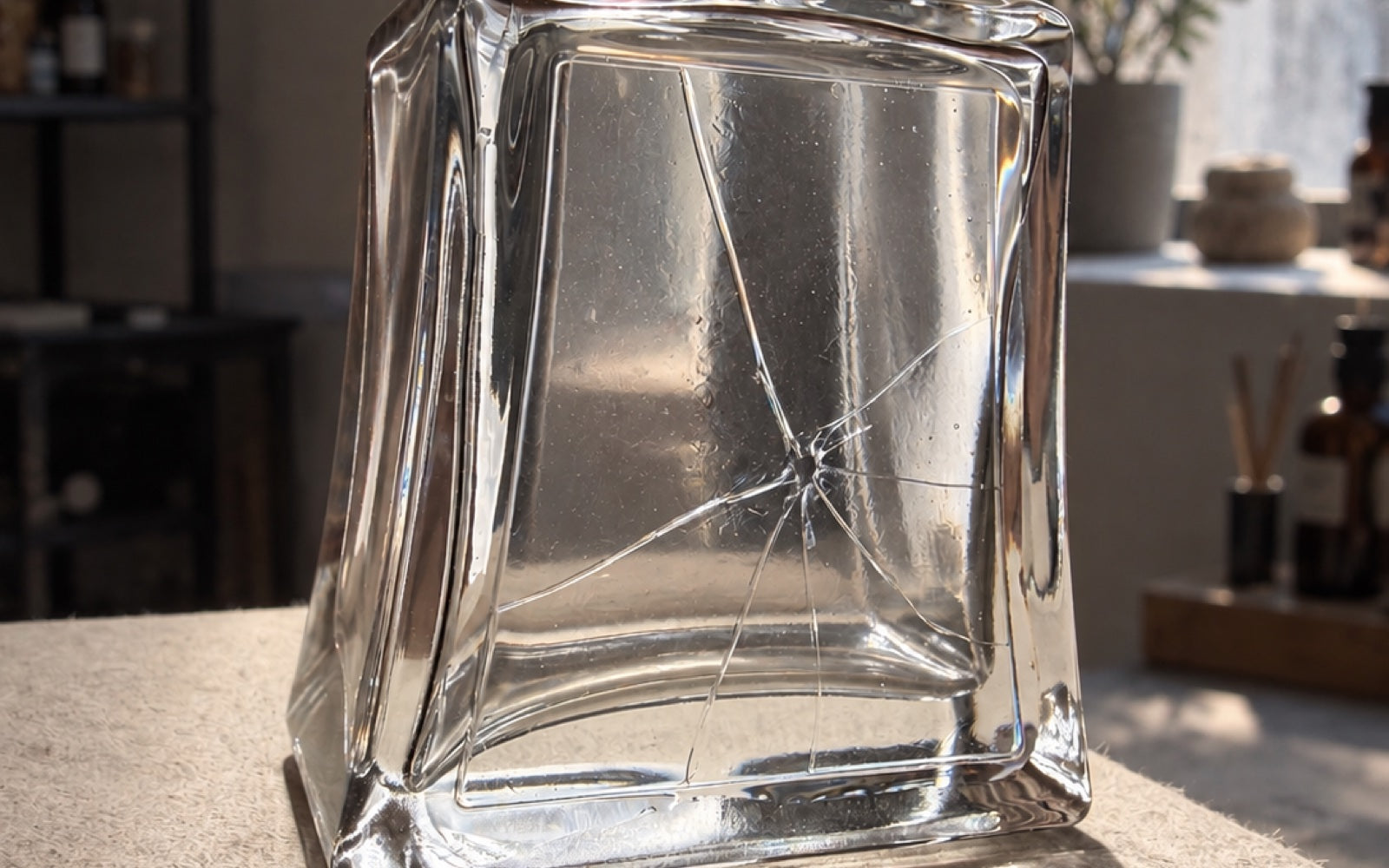
- The bottle is moulded whole, with a shallow recess in its front face. The recess is part of the mould, not a cut made afterwards. The glass around it and behind it is complete, continuous and unmarked. On the inside, where the perfume sits, there is nothing but plain solid glass.
- A small, thin plate of glass is cracked by hand. One plate, one strike, one pattern. A fracture cannot be steered precisely, which is the point: no two plates break the same way, so no two bottles will carry the same crack.
- The cracked plate is set into the recess. It fits the recess exactly, and sits slightly below the level of the surrounding surface.
- Clear resin is poured over the plate. It runs into every line of the fracture, locks every edge in place, and is left to cure. Once hard, the surface is polished until it is flush with the rest of the bottle.
The result is a real fracture, with real depth, held permanently inside a clear, smooth, sealed layer, in a recess on the outside of a bottle whose own glass has never been touched. You can run a thumb across it and feel nothing but glass.
Why it is safe
We want to be plain about this, because "cracked bottle" is an alarming phrase.
The bottle you hold is an ordinary, whole glass bottle. Its walls are intact. The perfume inside never touches the crack, and the crack never touches the perfume: between them is the solid glass wall of the bottle itself. The fractured plate has no exposed edge, because every edge is sealed under the resin. Nothing on the outside can flake, chip or come loose, because the whole assembly is polished flush and sits below the surface it was set into. As a bottle, it is as sound as one with no crack at all.
We also chose the materials with that in mind. The glass body is the highest grade our manufacturer offered, and the cap is made from the material used on the heaviest luxury caps rather than a standard plastic. These were not the cheapest options on the list, and we did not pretend otherwise to ourselves; they were simply the best ones available, and a bottle built around a deliberate flaw needs everything else about it to be beyond question.
Separately, the filled bottle is going through the compatibility and stability testing that any perfume sold in Europe has to document before it goes on sale. That testing is under way now. It treats our bottle as a container, exactly as it would treat any other, which is the point: on the inside, it is any other.
Why it has to be done by hand, one bottle at a time
The cracking is the easy part. The delicate part is the resin.
Pour slightly too much and it rises above the surface in a dome, which then has to be ground back. Pour slightly too little and it does not fill the fracture, and you can see the gap. Pour it carelessly and it traps bubbles along the crack, exactly where the eye looks first. Pour it well and there is still the question that matters most: has the resin filled the crack so completely that the crack has disappeared? A fracture that is perfectly sealed and perfectly invisible is a failure. The light has to keep finding it.
Then you wait. The resin takes days to cure before you can judge any of this, so every attempt is a two- or three-day experiment, and every lesson arrives slowly.
We will be honest about where we are, since that is what this Journal is for. Our first attempt this week used slightly too much resin; it rose a little above the surface, and the next attempt will use less. We have a small number of sample bottles to practise on, so we are being careful with them. We do not yet have a finished bottle we would send to anyone. We do have a method that works in principle, a bench covered in small glass plates, and a clearer idea each day of what "enough resin" means.
The factory could do this step. We chose to keep it, for reasons we set out last week, and this week made the trade-off concrete: it is slower, it is done by a person, and it is the reason each bottle will be different from the next.
The shape: half a year, and a joint called chigiri
The crack is the last thing that happens to the bottle. The first thing was its shape, and that took more than half a year of work with designers in Japan: drawings, models, rejected versions, and a long argument about how a bottle should sit in the hand.
The idea they kept coming back to was chigiri, a technique Japanese woodworkers have used for generations. When a board splits, instead of throwing it away or gluing the split shut and hiding it, the maker cuts a small bow-tie-shaped key into the surface across the crack. As one Japanese tool maker describes it, a butterfly key is "a small, bow-tie-shaped piece of wood set into the surface of a board to reinforce a crack or a seam," and it is "valued as much for how it looks as for what it does." The split stays visible. The key holds it. The board is stronger, and it is more beautiful for showing what happened to it.
That is the whole brief for our bottle in one object: a thing that can carry a crack and still hold together, and that does not pretend the crack is not there. The silhouette borrows from the key; the recess and the plate are the crack; the resin is what holds it.
What the crack is for
We make perfume around a single idea, which we call Own Your Scars. The marks that life leaves on a person are not a defect to be concealed. They are part of who that person is, and often the most honest part. Our bottle is that idea made physical. It does not hide its crack under lacquer, and it does not dress it up as an ornament. It shows it, accepts it, and holds it, and we think that is what makes it beautiful.
That is also why the finishing is done by hand, by someone who knows what the crack is for. It would be faster to have a machine do it. But every bottle in the first release will have been cracked and sealed by a person, one at a time, with that idea in mind, and we would rather it took longer.
What happens next
The production parts arrive by sea in the coming weeks. Until then we keep practising on the samples until the method is settled: the right amount of resin, the right way to strike the plate, the right polish. Then the bottles are filled in France, finished here, and boxed in the packaging that is already made and waiting.
We are not putting a date on the launch, for the same reason as last week: it depends on a ship and on a resin that cures in its own time. What we can say is that the bottle is no longer a question of whether. It is a question of how well, and that is a question we get to answer with our own hands.
If you would like to see the first finished one when it exists, our waitlist is where it will go first; the link is in the footer.