
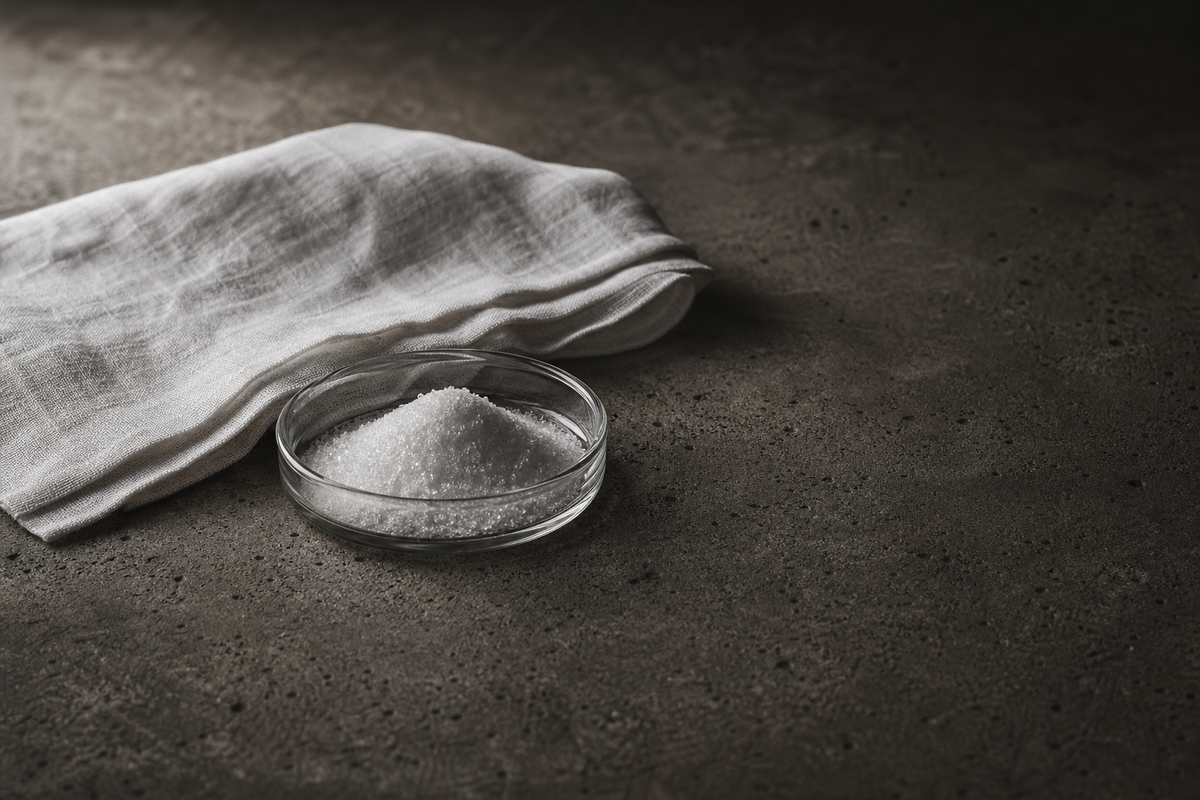
Musk is one of the most common materials in perfume, and almost none of it comes from where the word comes from. The name originally meant a secretion from a gland of the male musk deer. Today, the musk in the great majority of perfumes, shampoos and laundry detergents is made in a laboratory, from molecules that were discovered by accident, puzzled over by chemists for decades, and in one case helped a chemist win a Nobel Prize.
In this article we explain what musk originally was, why it was so valuable, what replaced it, what the four families of modern musk are, and what "white musk" on a label actually means.
What is musk?
Musk is a family of smells rather than a single material. People describe it as soft, warm, powdery, skin-like and slightly sweet. Some musks smell almost like clean skin; others like freshly washed cotton; the older ones have a darker, animal edge.
The word has travelled a long way. It came into European languages through Late Greek moskhos, from the Persian mushk, which in turn goes back to the Sanskrit muṣka, meaning "testicle". The name was a description of what the gland looked like, not of what it did.
That gland belongs to the male musk deer, a small, tusked deer of the mountain forests of Asia. It sits under the skin of the abdomen and produces a strong-smelling secretion. Dried, the contents of the gland (called the pod) become a dark, granular material known as musk grain.
Why natural musk was so valuable
Musk has been used for a very long time. A 1999 report by TRAFFIC, the wildlife-trade monitoring network, states that in East and South Asia musk had been used in medicine and as a perfume for about 5,000 years, and that it had also been used in European perfumery for some hundreds of years.
It was valuable because there was so little of it. According to the same report:
- Only male musk deer produce musk, at a rate of about 25 grams per animal per year.
- Musk pods were traditionally harvested by killing the deer, although it is possible to take musk from a living animal.
- Hunting was wasteful: traps and snares killed an estimated three to five deer for every male with a large enough gland. With about 40 suitable males needed for each kilogram of musk, that meant around 160 deer killed per kilogram.
- In the late 1990s, retail prices for musk in Europe and Japan were three to five times the price of gold at the time.
All musk deer species have been listed under CITES, the international treaty that controls trade in endangered species, since 1979. Some populations are on its strictest list, where international commercial trade in wild specimens is prohibited; the rest are on the list that requires trade permits. TRAFFIC reported that the use of natural musk in the European perfume industry declined through the 1990s, as synthetic musks increasingly replaced it.
What replaced it: four families of synthetic musk
Chemists usually group synthetic musks into four families. They were discovered in roughly this order.
- Nitro musks (from 1888): musk ketone, musk xylene, musk ambrette. The first synthetic musks. Several are now banned or restricted in cosmetics in the EU.
- Polycyclic musks (mid-20th century): Galaxolide, Tonalide. Stable in soap and detergent, and behind much of the "clean laundry" smell.
- Macrocyclic musks (structure solved in 1926): muscone, ambrettolide, Exaltolide. Large ring-shaped molecules, the closest in structure to the natural material.
- Alicyclic musks (from 1990): Helvetolide. The newest family, with a different molecular structure again.
Nitro musks: an accident in explosives research
The first synthetic musk was found by mistake. In 1888 the chemist Albert Baur was trying to make a more effective version of the explosive TNT. One of the compounds he produced had a strong musky smell. That became the first family of synthetic musks, the nitro musks, and it made a musky smell far cheaper than anything taken from an animal.
Nitro musks were used heavily for decades, but some of them turned out to have safety problems. In the EU today, musk ambrette, musk tibetene and musk moskene are prohibited in cosmetic products, and musk xylene and musk ketone are allowed only with restrictions.

Polycyclic musks: the smell of clean cotton
The second family, polycyclic musks, is chemically different and much more stable. The best known is Galaxolide, a name owned by the fragrance company IFF. From the late 1960s it went into fabric softeners and detergents, and it is still used in very large quantities today.
This is the reason many people describe musk as smelling "clean". Much of what we think of as the smell of freshly washed laundry comes from musks like this one. When a perfume smells of clean skin or fresh sheets, a polycyclic musk is often part of the reason.
Macrocyclic musks: the Nobel Prize ring
The third family goes back to the natural material itself. Between 1924 and 1926, the chemist Leopold Ruzicka worked out the structure of muscone, the main smelling molecule of deer musk, and of civetone, the equivalent from the civet. Both turned out to be single rings of carbon atoms: 15 in muscone, 17 in civetone. At the time, chemists believed that rings of more than eight atoms were too unstable to exist.
Ruzicka's work was part of the research recognised with the 1939 Nobel Prize in Chemistry. The musks built on it are called macrocyclic ("large ring") musks. They are the closest in structure to natural musk and are prized for their softness, although they were for a long time harder to produce than the older families. Ambrettolide, one of them, is also found in nature, in the seed of the ambrette plant.
Alicyclic musks: the newest family
The fourth family arrived in 1990 with Helvetolide, the first commercial alicyclic musk. Its molecular structure differs from the ring-based musks before it, which gives perfumers another kind of musk to work with.
Are there plant musks?
Yes, a few plants produce musky-smelling materials. The best known is ambrette seed, from a hibiscus relative (Abelmoschus moschatus), which contains musky compounds including ambrettolide. Angelica root also has a musky facet. These are real natural materials, but they are rare and costly, and they do not smell exactly like deer musk or like the laundry-style synthetics.
What does "white musk" mean?
"White musk" is a style, not a material. The term is used for the clean, soft, laundry-like musks made in the laboratory, as opposed to the darker, animal-like character people associated with the original. There is no single ingredient called white musk, and there is no standard definition of how much of what a perfume must contain to use the name. If you like a "white musk" perfume, what you like is most likely a blend of synthetic musk molecules from the families above.
Why is musk in so many perfumes?
Musks do three jobs at once.
- They last. Musk molecules are large and evaporate slowly, which is why they sit in the base notes, the part of a perfume you still smell hours later. (We explain top, heart and base notes here.)
- They smooth. A small amount of musk rounds off sharper materials around it and makes a blend feel softer and more finished.
- They sit close to skin. Many musks read less like a separate smell and more like a warmer version of the wearer's own skin.
One more thing is worth knowing: not everyone can smell every musk. Some people have a genetic variant that makes a particular musk molecule faint or invisible to them. We covered this in Why Can't I Smell My Own Perfume?. If a perfume described as "musky" seems nearly scentless to you from the first minute, that may be the reason.
How we approach musk at SHŌ ITO
Our first perfume, KIMONO, has musks in its base, alongside hinoki wood, patchouli, benzoin and oakmoss. Their job there is the one described above: to hold the heavier materials together, to carry the perfume into its later hours, and to keep the base close to the skin rather than loud.
We have one rule for how we describe it, which is the same rule we gave for amber: when a word covers several different things, we try to say which one we mean. "Musk" on a perfume's list of notes almost never means the gland of a deer. It means a family of soft, slow, skin-like smells, most of them the work of chemists over the last 130 years. For a broader look at how natural and laboratory-made materials sit together in modern perfume, see Natural vs Synthetic Perfume Ingredients.
The short version
- Musk originally meant a secretion from a gland of the male musk deer. Only males produce it, around 25 grams a year.
- Because of hunting, all musk deer have been protected under CITES since 1979, and natural musk has almost disappeared from European perfumery.
- Modern musk comes in four synthetic families: nitro, polycyclic, macrocyclic and alicyclic.
- The "clean laundry" smell is largely polycyclic musk. "White musk" is a style name, not an ingredient.
- Musks last, smooth and sit close to skin, which is why so many perfumes use them.
If you would like to know when KIMONO is available, our waitlist is the first place we will say so; the link is in the footer.