
You stop smelling your own perfume because your brain turns down smells that stay constant. The perfume is usually still there, and the people around you can usually still smell it. What has changed is you. Scientists call this olfactory adaptation; most people call it nose blindness or olfactory fatigue.
This matters for a practical reason. The natural response to "I can't smell it any more" is to spray more, and that is almost always the wrong one. In this article we explain what adaptation is, what the research says about how fast it happens and how long it lasts, why the coffee beans on perfume counters do not do what people think, and what helps instead.
One note before we start. A perfume can also genuinely leave your skin quickly, for reasons that have to do with the skin and the formula. That is a different problem, and we covered it in Why Does Perfume Fade So Fast on Me?. This article is about the case where the perfume is still there and you are the one who has stopped noticing.
What is nose blindness?
Researchers use two words for it, and the difference is useful. In a 2017 review in Physiology & Behavior, Pellegrino and colleagues define habituation as the decreased behavioural response to a smell after repeated exposure — you notice it less. Adaptation is the neural process underneath that produces the decrease.
Every sense does this. You stop feeling your watch on your wrist and stop hearing the refrigerator. Pamela Dalton of the Monell Chemical Senses Center, in a widely cited 2000 review in Chemical Senses, puts the purpose in one line: sensory adaptation allows organisms to "respond primarily to changes in stimulation." A smell that has not changed for a while carries no new information, so it is turned down to leave room for one that might.
Three features of adaptation, all from Dalton's review, explain most of what perfume wearers experience:
- It is specific. Exposure leads to "stimulus-specific decreases in olfactory sensitivity to that odorant." You go blind to your perfume, not to smells in general.
- It is reversible. "Sensitivity recovers over time in the absence of further exposure."
- It depends on dose. How deep it goes and how long recovery takes "are dependent on the concentration of the odor and on the duration of exposure."
Does it happen in the nose or in the brain?
Both, but mostly in the brain. Dalton's review describes adaptation at "multiple levels": a peripheral part, in the receptor cells inside the nose, and a central part, further along in the brain. The 2017 review concludes that habituation to odours is "relatively fast," with adaptation "occurring more quickly at higher cerebral processes than peripheral adaptation."
A study published in 2021 in the European Archives of Oto-Rhino-Laryngology tested this directly. Researchers placed an electrode on the smell-sensing tissue inside the noses of 35 volunteers and presented the same odour ten times in a row, a few seconds apart. The electrical response of the tissue "did not significantly decrease over 10 repeated exposures to any odorant." A few individuals did show a decline, so the authors do not rule out adaptation in the nose itself. But the overall picture is that your nose keeps reporting the perfume, and your brain stops passing the report on.
That is why "fatigue" is a slightly misleading word. Nothing is worn out. It is a filter, and it is working as intended.
Which smells do we stop noticing fastest?
Not all smells fade from attention at the same speed. In a 2017 study in Scientific Reports, 58 participants continuously rated the intensity of 32 different odorants for 120 seconds each. The odorants that people habituated to least were "more intense, more trigeminal" (meaning they also trigger the nerve that senses sting and cooling, as menthol and ammonia do) and had higher vapour pressure — they evaporate readily. They also had lower molecular weight and were rated less pleasant.
Turn that around and you get the profile of a smell the brain lets go of easily: not sharp, heavy, slow to evaporate, and pleasant. The study did not test perfumes. But that description fits the materials that make up the base of most perfumes — the musks, woods and resins we described in our guide to top, heart and base notes. The bright, sharp opening of a perfume is hard to ignore. The soft base that remains for the rest of the day has exactly the properties that habituate.
How long does nose blindness last?
After a short exposure, recovery comes with time away from the smell. Long, repeated exposure is different. In 1996, Dalton and Charles Wysocki placed an odorant in volunteers' homes for two weeks. Afterwards, the volunteers' detection thresholds for that odorant had risen — they needed more of it in the air to notice it at all — and the reduction was specific to that odorant. The effect also lingered: "For most individuals, reduced sensitivity to the test odorant was still evident up to 2 weeks following the last exposure."
That study used a room odorant, not perfume on skin, so treat it as a parallel rather than proof. But it matches a common experience: the perfume you have worn every day for years is the one you can smell least, even when you first put it on.
What you believe about a smell changes how you adapt
Adaptation is not purely mechanical. In another 1996 experiment, Dalton exposed three groups to the same odour. Those told it was a natural, healthy extract adapted to it. Those told it was potentially hazardous showed "apparent sensitization" — it seemed to get stronger. Yet threshold tests before and after showed the usual adaptation underneath. The nose had adapted in every group; what differed was how much attention the brain kept giving the smell.
Do coffee beans reset your nose?
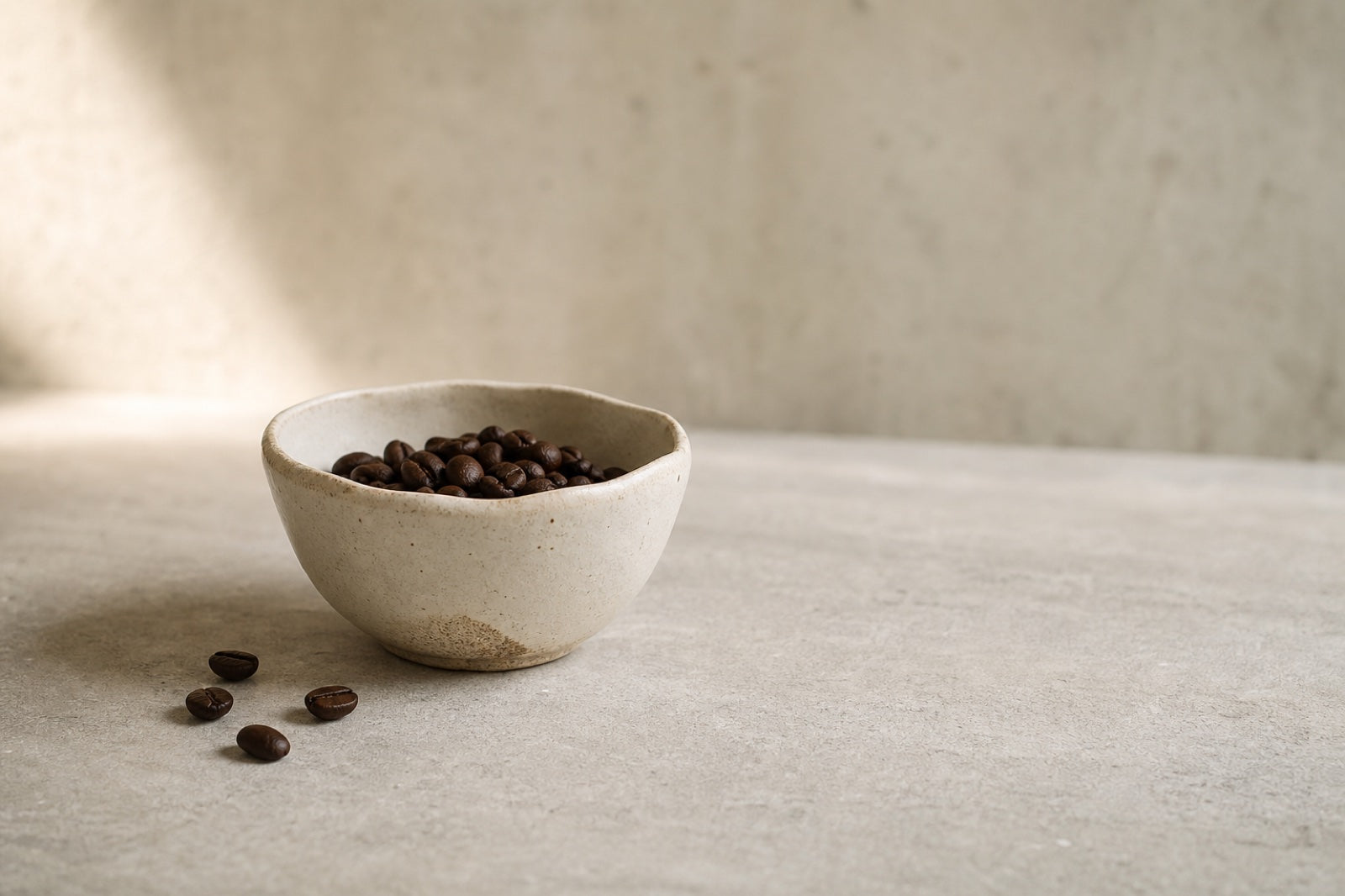
Many perfume shops keep a jar of coffee beans on the counter so that customers can "reset" between fragrances. A team at Beloit College tested the practice in a small exploratory study published in Perceptual and Motor Skills in 2011. Participants smelled three fragrances repeatedly, then sniffed coffee beans, lemon slices or plain air, and were then asked to pick out a fourth fragrance they had not smelled before. The result: "Coffee beans did not yield better performance than lemon slices or air."
That is consistent with everything above. Adaptation is specific to the smell you have been exposed to, and it recovers with time away from that smell. Another strong smell does not speed this up; it only adds a new thing to adapt to. What helps in a shop is a pause and ordinary air.
Nose blindness, or a smell you have never been able to detect?
There is a different situation that is easy to confuse with adaptation. Some people have never been able to smell a particular molecule at all. This is called a specific anosmia: an otherwise normal sense of smell with one blind spot.
Musks are the classic example. A 2022 genetics study in PLoS Genetics, covering 1,000 Han Chinese participants and a second, ethnically diverse group of 364, identified a smell receptor, OR4D6, that responds to the musk Galaxolide. Participants who carried two copies of a particular variant of that receptor gene were unable to smell Galaxolide. We described a similar finding for an ambergris molecule in our article on amber.
The difference in practice: if a perfume disappears for you after twenty minutes, that is adaptation. If a perfume that others describe as musky smells thin or nearly absent to you from the very first second, part of it may simply be outside what your receptors can detect.
When it is not normal
Nose blindness is limited to one familiar smell and goes away. A general loss of smell is something else. The US National Institute on Deafness and Other Communication Disorders lists ageing, sinus and upper respiratory infections, head injury and certain medications among the causes of smell disorders, and its advice is direct: "If you are experiencing a smell disorder, talk with your doctor."
How we approach it at SHŌ ITO
Our perfume is made at extrait de parfum strength, which means each spray carries a large amount of scented material. That makes nose blindness more than a curiosity for us. If someone judges the right amount by what they themselves can still smell, they will over-apply — and the people near them, who have not adapted, will get the full dose.
So this is what we would say to anyone who tells us they can no longer smell their perfume by lunchtime:
- Do not top up because you cannot smell it. Your own nose is the least reliable instrument in the room for this one smell. Start with the amount we suggested in our guide to applying perfume — one spray on the neck and one on a wrist — and hold it there.
- Ask someone who has just arrived. A person who walks into the room has not adapted. One honest answer from them is worth more than an afternoon of sniffing your own wrist.
- Give it time and ordinary air. Step outside for a while, or simply leave it until the evening. When you pick up the scarf or shirt you wore the next morning, you will usually find the perfume was there all along.
- Do not wear the same perfume every single day if you want to keep smelling it. The research on long-term exposure points one way: the more constant the smell, the more completely it is filtered out.
- Think about where it sits. Adaptation depends on concentration and duration. Perfume sprayed just under your chin feeds your nose a steady stream all day. On the wrists or the back of the neck, it reaches you in passing moments instead, and each one is a small change that your brain will register.
We also keep this in mind when we describe our own work. We do not make promises about how long our perfume lasts, because part of what people report as lasting — or not lasting — is their own adaptation rather than the perfume. We would rather explain how the mechanism works and let you judge for yourself.
Summary
- You stop smelling your own perfume because your brain filters out constant smells. This is olfactory adaptation, often called nose blindness.
- It happens mostly in the brain, not in the nose, and it is specific to the smell you have been exposed to.
- Soft, heavy, pleasant smells are the easiest to tune out — a description that fits most perfume bases.
- After weeks of constant exposure, recovery can take up to two weeks, according to a home-exposure study.
- Coffee beans did no better than plain air in the one study that tested them. Time and ordinary air are what restore your sense of a smell.
- Do not respray because you cannot smell it. Other people have not adapted.
If you would like more explainers like this one, our newsletter, The Hidden Nose, arrives every Sunday; the sign-up link is in the footer.