

Inside the parcel, the box that holds our perfume is wrapped in a piece of real kimono silk. Before we looked at the colour, the pattern or the price of that silk, we did something else first. We smelled it.
That was one of two surprises in what we thought would be the easy part of our packaging. The other was that we could not buy the cloth in the size we wanted, from anyone, and the reason turned out to be centuries old.
This is the story of how the wrapping was decided. If you have ever bought vintage kimono fabric, or wondered how to wrap a box in cloth without a single piece of tape, some of it may be useful to you as well.
Why cloth at all
We wrote in July about designing the box before the bottle: the idea that the first thing your hands do with a perfume is unwrap it, so the unwrapping deserves as much thought as the object.
Our first plan was the usual one, a clear plastic film around the box. We dropped it. Film can need a fingernail or scissors to open, it is thrown away the moment it is off, and its real job is to protect a box from handling on a shop shelf. We sell online only, so that job does not exist for us.
The second plan was wrapping paper held with paper tape. Then we sat down with the actual papers and the actual box and tried it by hand, many different ways. Cloth added something that paper alone could not. A layer of silk between the box and the paper changes what your fingers feel when you open the parcel, and it does not need tape, because cloth can be tied.
So the order became: the box in its sleeve, then silk, then crumpled soft paper as cushioning, then a thin sheet of tissue around the whole thing, closed with a seal.
The perfume is called KIMONO, and it was built around the smell of a person wearing one. Using the cloth itself was not a decoration we added afterwards. It was the most direct material available.
Surprise one: you cannot buy it wide
We wanted squares of roughly 45 to 50 centimetres. That seemed like a modest request.
Every source we found offered pieces 35 to 38 centimetres wide. Not most of them. All of them. Longer pieces were easy to find. Wider ones were not.
The reason is that kimono cloth is not cut from wide rolls the way most fabric is. It is woven as a tanmono: a single narrow bolt, about 35 to 40 centimetres wide and roughly twelve metres long. One bolt makes one kimono. The garment is assembled from straight panels cut across that bolt, with almost nothing left over.
The width itself comes largely from the loom. On a traditional hand loom, the weaver throws the shuttle from one hand to the other across the cloth, and around 40 centimetres is the distance a person can do that comfortably and accurately, all day. The width is set by the weaver's hands. Bolts for men's kimono are woven a little wider, and vintage bolts from the last century are often a few centimetres narrower than today's. Either way, it stays close to that figure.
So a 50-centimetre square cut from a standard kimono bolt does not exist. The cloth is simply never that wide. You would have to sew two pieces together, or go looking for a different kind of cloth altogether.
Once we understood that, the question changed. We stopped looking for a rare wide cloth and asked instead whether the standard one would do. The length of a piece is free, because it is simply where the bolt is cut. We took a piece 35 by 50 centimetres, put our real box on it, a box about twelve centimetres square and nine tall, and tried. It wraps. The width was never the problem we thought it was.
Surprise two: the first test was the nose
A kimono is not treated like ordinary clothing. A good one is kept for decades and handed down, and between wearings it is folded away in a chest. To protect it from insects, it is traditionally stored with a repellent, and the classic one is camphor, which has a sharp, medicinal smell of its own. Mothballs are common too.
Silk that has spent thirty years in a drawer with camphor can carry that smell. For most uses of old kimono fabric, a bag, a cushion, a quilt, this is a minor nuisance that airing will usually reduce, though not always remove.
For us it would be a disaster. Imagine opening a perfume you have waited for and the first thing you smell is a wardrobe. The wrapping would speak before the perfume did, and it would say the wrong thing.
So before anything else, we set two rules.
First, we looked for cloth that had never been a garment. A lot of the kimono fabric sold in small pieces comes from old kimono that have been taken apart. But there is another kind: new offcuts and remnants from the people who dye and finish the cloth in the first place. That silk has never been worn, and it has never been stored with anything.
Second, we did not trust the description. We ordered a small batch and tested it ourselves before committing to more. The test had three parts: smell it, feel the thickness, look at it. Smell came first because it was the one that could end the idea on the spot.
It passed. No repellent, no storage smell, nothing that would compete with what is inside the box. The thickness of the silk was right, and we liked the way it looked very much.
The part that took longest was the simplest
With the cloth approved, we assumed we were finished. We were not. We could not make it look good.
Wrapping a box neatly in a narrow rectangle of silk is harder than it sounds. We tried one way after another and none of them looked clean enough. For a while the wrapping was the single thing holding up every other packaging decision, because we did not want to order cloth in quantity until we knew exactly how it would be used.
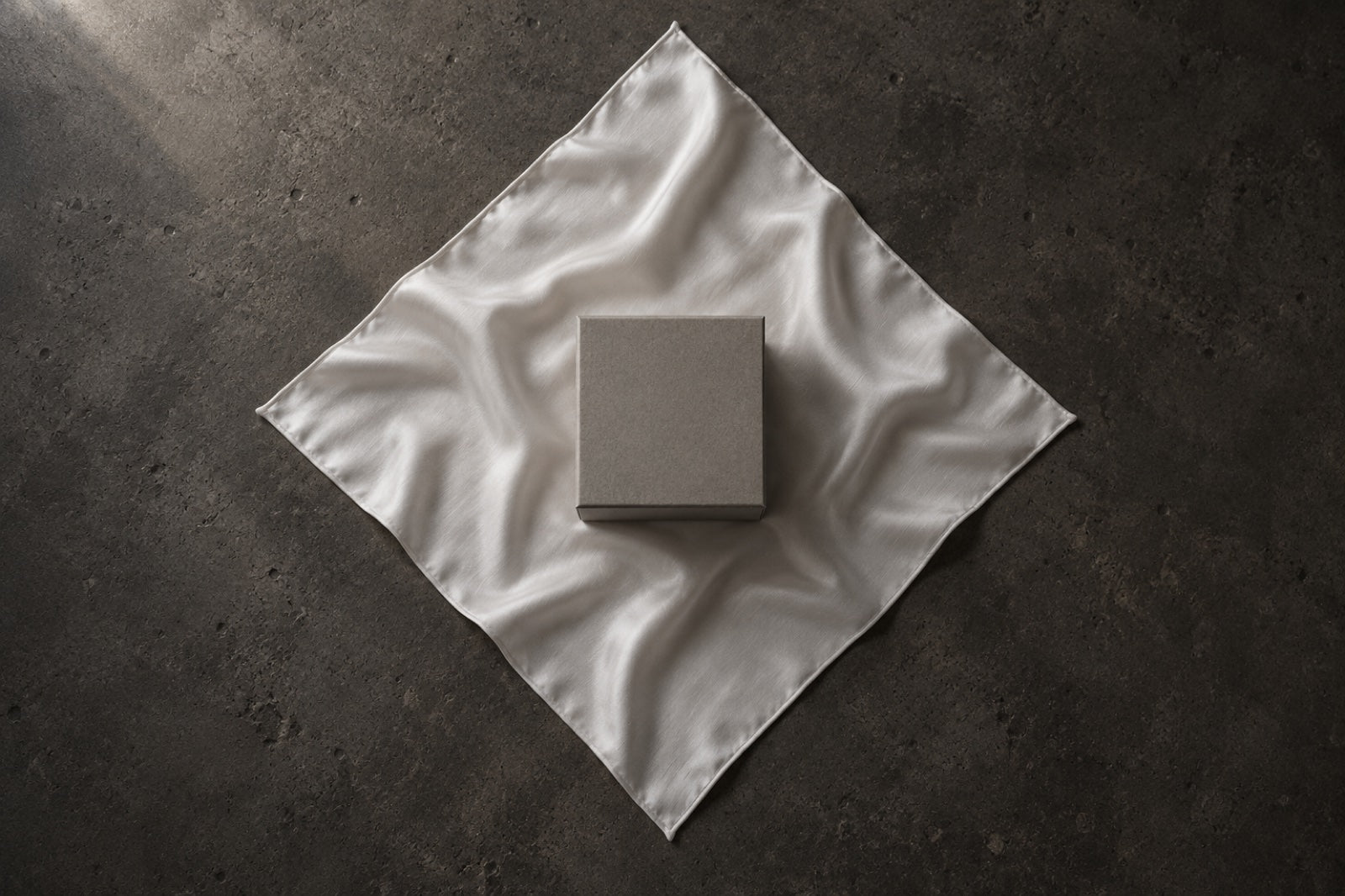
The answer, when it came, was the oldest one available. Lay the cloth out as a diamond, put the box in the middle, and bring the opposite ends up and tie them. It is how a furoshiki, the Japanese wrapping cloth, has been used for centuries: no tape, no pins, and a knot that the person receiving it unties by hand.
It also makes the most of a narrow cloth. Measured corner to corner, a piece 35 by 50 centimetres is about 61 centimetres long.
One more idea was tested and dropped along the way. We tried adding a layer of honeycomb paper over the silk for protection. It cushioned less than we expected and it spoiled the shape of the wrapping, so it went. The crumpled paper does that job instead.
Where this stands
The cloth is chosen, the size is fixed and the method is decided. What we have not yet done is place the order for the full quantity, so we are not going to describe that as finished.
One thing will be true whichever way that goes. Remnants are what they are, so the pieces will probably not be identical from one parcel to the next. We have decided that this is acceptable. It suits a bottle that is finished by hand, one at a time.
Three things worth knowing if you buy kimono fabric
- Expect it to be narrow. Around 35 to 40 centimetres is normal, because that is how the bolt is woven. Plan your project around the width instead of searching for a wider piece.
- Smell it before you use it. Fabric taken from old kimono may carry camphor or mothball odour from storage. If the smell matters for what you are making, ask the seller whether the cloth is new or from a used garment.
- A cloth can replace both paper and tape. Lay it as a diamond, put the box in the centre, tie the opposite ends. It works with any square or rectangular cloth, and the wrapping becomes part of the gift.
If you would like to see the finished parcel when the first ones go out, our waitlist is where that will appear first; the link is in the footer.